
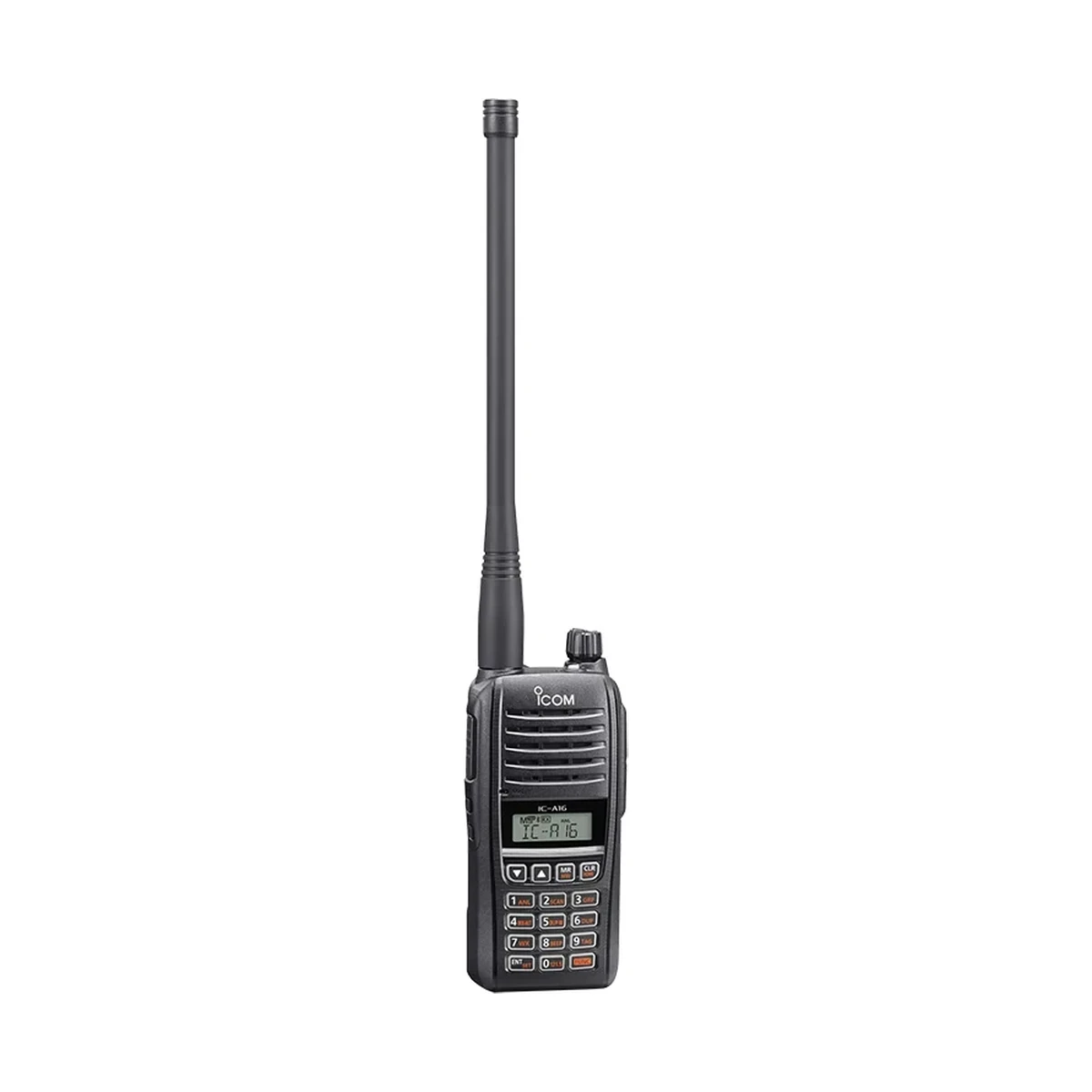
A handheld aviation transceiver serves as a backup radio, a ground communication tool, or the primary radio for an aircraft that carries no panel-mount unit. Icom's IC-A16 and the IC-A25N/IC-A25C pair both fill that role, and the choice between them comes down to whether built-in navigation capability is worth paying and carrying extra weight for.
What the IC-A16 offers
The IC-A16 is a straightforward, capable VHF air band handheld: 118.000 to 136.99166 MHz transmit, 108.000 to 136.99166 MHz receive extending down into the NAV band, plus a dedicated weather channel receive range of 161.650 to 163.275 MHz. It supports both 8.33 kHz and 25 kHz channel spacing across 200 memory channels, outputs 6 W PEP / 1.8 W carrier, and delivers a loud 1500 mW of internal audio, useful in a noisy ramp environment. Built-in Bluetooth allows hands-free operation, and a large-capacity battery pack is rated for roughly 17 hours of use. At 257 g with its BP-280 battery, it is a genuinely compact, straightforward communication radio.
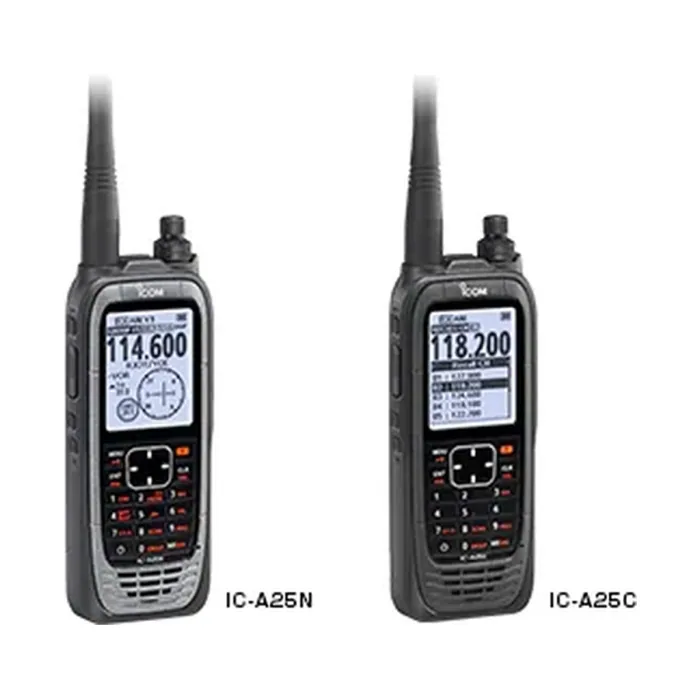
What the IC-A25 series adds
The IC-A25N and IC-A25C share the same VHF communication core, 300 memory channels across 15 groups against the IC-A16's 200, and the same weather channel reception, but the N and C variants differ from each other in one specific way: the IC-A25N adds built-in GPS with simplified waypoint navigation, VOR navigation functions, a near-station search function, and flight plan support through a companion Android and iOS app, while the IC-A25C provides communication channels only, without those navigation features. In other words, the choice within the IC-A25 pairing itself is a navigation question before the comparison against the IC-A16 even begins.
Comparing IC-A16 against IC-A25C
Set the IC-A25N's navigation features aside, and the IC-A16 versus IC-A25C comparison is largely about memory channel count, 200 versus 300 across 15 groups, physical size and weight, the IC-A16 being the smaller and lighter of the two at 257 g against the IC-A25 series' 340 g, and connectivity extras Icom has added to the newer A25 platform. For a buyer who wants a compact, no-frills communication backup and nothing more, the IC-A16 remains a fully capable choice at a smaller size.
Comparing IC-A16 against IC-A25N
Here the decision becomes clearer. If GPS-based waypoint navigation, VOR functions or app-based flight plan support have any value to your operation, the IC-A25N is the only option between the three that offers them at all; the IC-A16 has no navigation capability built in whatsoever, being a pure communication and weather-monitoring radio.
Choosing between them
- Want the smallest, lightest backup communication radio with no navigation features: the IC-A16.
- Want the IC-A25 platform's larger memory and connectivity, but have no interest in built-in navigation: the IC-A25C.
- Want a handheld that can also provide basic GPS waypoint guidance and VOR navigation as a genuine backup, not just a backup radio: the IC-A25N.
- Flying an aircraft with no panel-mount navigator and wanting the handheld to cover some of that gap: the IC-A25N's navigation features make it the more capable single unit, though it remains a supplement to, not a substitute for, certified navigation equipment.
ASPL supplies the full Icom aviation handheld range and can talk through which specific features are worth paying for in your operation before you buy.