
Why gases are not treated as one hazard
Different flammable gases and vapours ignite at different minimum spark energies and temperatures. A protection method that safely contains or limits energy below the ignition threshold of one gas may not do so for a more easily ignited one, which is why ATEX and IECEx certification for Group II surface equipment is split into gas subgroups rather than a single blanket gas rating.
The three subgroups
IIA covers gases represented by propane, the least easily ignited of the three reference gases and the baseline subgroup. IIB covers gases represented by ethylene, requiring a more demanding protection standard. IIC covers gases represented by hydrogen and acetylene, the most easily ignited substances the classification system addresses, and equipment certified to IIC has been tested to the most stringent requirement of the three.
Why IIC covers IIB and IIA, but not the reverse
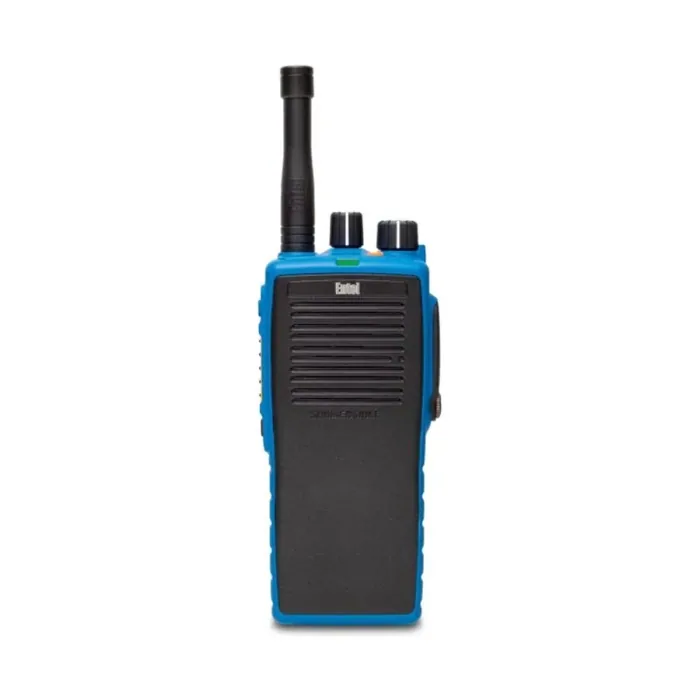
Because IIC represents the most demanding test requirement, equipment certified to IIC is automatically suitable for IIB and IIA atmospheres as well; passing the harder test implies passing the easier ones. The reverse does not hold: equipment certified only to IIB has not been tested against the more demanding IIC requirement and should not be assumed safe in a IIC atmosphere without that specific certification. This is precisely why Entel's range includes both ratings side by side rather than a single standard specification: the Entel DT982M and DT985M are certified II 2G Ex ib IIC T4 Gb, the broader rating, while the DT885M and DT882M are certified II 2G Ex ib IIB T4 Gb, sufficient for many sites but not interchangeable with a IIC requirement.
What determines which gas group a site actually needs
The gas group required is a property of the site's own process chemistry, not a preference to be chosen freely. A facility handling hydrogen, a common presence in refineries, petrochemical plants and certain industrial processes, needs IIC-rated equipment throughout any hazardous area. A facility whose hazard is limited to substances in the IIB or IIA range can specify accordingly, though many operators standardise on IIC-rated equipment across a whole site specifically to avoid managing multiple certification tiers and to future-proof against a process change that introduces a more demanding gas.
Confirming your site's classification
The specific gas group and zone classification for a given hazardous area is determined by the site's own hazardous area classification study, typically documented and maintained by the facility's own safety or process engineering function, not inferred from the general type of industry. A refinery and a grain storage facility have entirely different hazard profiles despite both being industrial sites, and the correct gas group follows from that classification study rather than from an assumption based on the sector alone.
A practical checklist
- Obtain your site's documented hazardous area classification, including the specific gas group, before specifying radio equipment, rather than guessing from the general industry type.
- If any part of the site handles hydrogen, acetylene or similarly reactive substances, IIC-rated equipment is required for that area; IIB-rated equipment is not a substitute.
- Where a site has mixed zones with different gas classifications, it is often simpler and safer to standardise on IIC-rated equipment across the whole fleet than to track which radio is approved for which specific area.
- Never assume a lower-rated radio is "probably fine" for a higher gas group; the certification exists precisely because that assumption cannot be verified without the actual testing behind it.
ASPL supplies Entel's full ATEX range across both IIB and IIC gas groups and can help confirm which rating a specific site's classification actually requires before equipment is specified.