
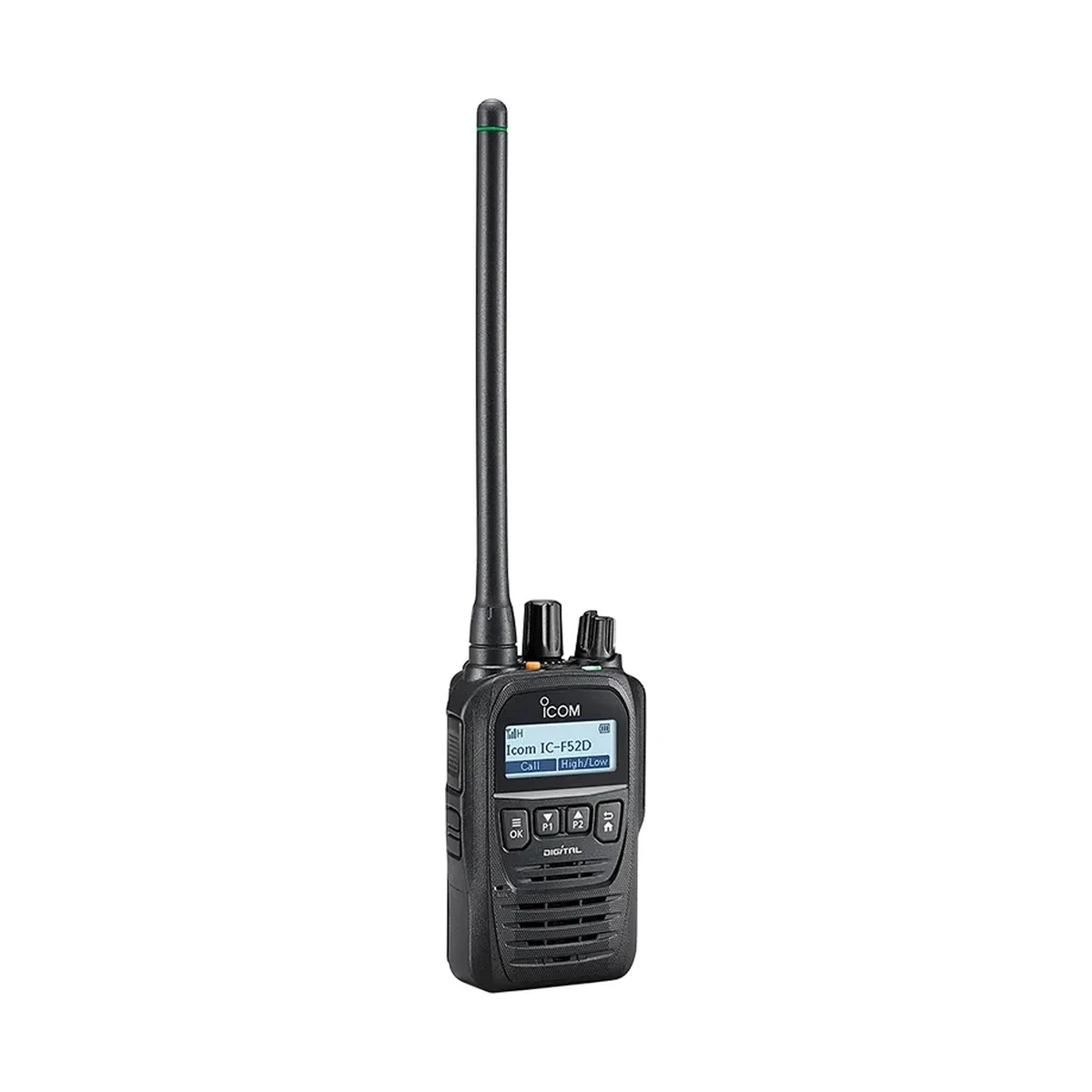
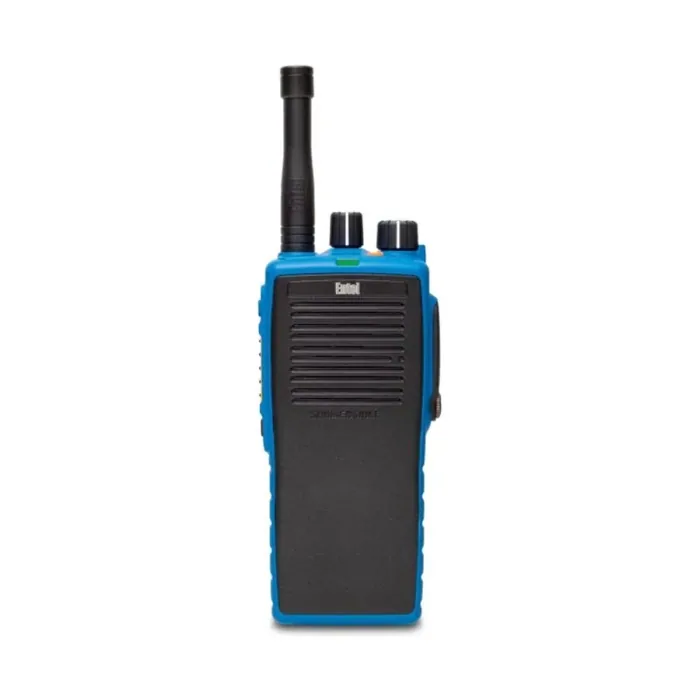
Where a hazardous-area fleet needs digital radio capability, individually addressed calling, data messaging, higher channel capacity, alongside intrinsic safety certification, two ranges in this catalogue meet that requirement: Entel's DT982M and Icom's IC-F52D-UL (VHF) and IC-F62D-UL (UHF). Both are ATEX-rated digital handhelds, and choosing between them involves the same protocol question covered in more depth in this catalogue's land mobile radio content, plus a few differences specific to their hazardous-area configuration.
Digital protocol: DMR versus NXDN/dPMR
The DT982M runs DMR, certified compliant with ETSI TS 102 361, the same protocol standard behind Motorola's MOTOTRBO range. The IC-F52D-UL and IC-F62D-UL run Icom's NXDN and dPMR digital protocols, the same protocols behind Icom's standard, non-hazardous-area digital handhelds. As covered in more depth in the land mobile content elsewhere on this site, these protocols are not digitally interoperable with each other, which means the choice here is, as with the standard digital range, substantially a platform decision: if your site already runs a DMR repeater and fleet infrastructure, the DT982M fits it; if your site runs NXDN or dPMR infrastructure, the Icom UL pair fits it instead.
Channel capacity
The IC-F52D-UL and IC-F62D-UL offer a substantially larger channel capacity, 512 channels across 128 zones, against the DT982M's 16 channels across a single zone. For a large, complex multi-department hazardous site needing many distinct channels or a path toward trunking, the Icom pair's capacity is a meaningful practical advantage. For a smaller site or a fleet that genuinely only needs a handful of channels, the DT982M's more modest capacity is unlikely to be a real limitation, and, as covered in the channel-capacity article elsewhere in this catalogue's land mobile content, unused capacity is not itself a benefit.
Output power and battery
Both units transmit at broadly comparable power for hazardous-area handhelds, the DT982M at 1 W and the IC-F52D-UL/IC-F62D-UL offering selectable 5, 2 or 1 W. Intrinsically safe equipment is generally engineered to lower power levels than standard commercial radios specifically to keep circuit energy within intrinsically safe limits, so this is a lower ceiling than either manufacturer's non-hazardous-area handhelds, not a shortcoming specific to one brand over the other. Battery endurance on the DT982M is rated at up to 19.5 hours in digital mode on its 1800 mAh pack; confirm the equivalent figure for the specific IC-F52D-UL/IC-F62D-UL battery configuration against your shift-length requirement.
Gas group and zone rating
The DT982M carries the higher IIC gas-group rating, suitable for hydrogen and acetylene-class atmospheres as well as the less demanding IIB and IIA groups, as covered in the dedicated gas-group article elsewhere in this series. Confirm the specific Ex marking for the IC-F52D-UL/IC-F62D-UL configuration you are considering directly against the site's own gas-group classification before assuming equivalence between the two ranges, since hazardous-area certification is never a detail to infer by brand reputation alone.
Choosing between them
- Existing DMR infrastructure, or a preference for a widely deployed international digital standard: the Entel DT982M.
- Existing Icom NXDN/dPMR infrastructure, or a need for a large channel count and zone structure: the IC-F52D-UL (VHF) or IC-F62D-UL (UHF).
- Starting from no existing digital infrastructure: the decision should weigh dealer support and total cost of ownership in India as much as the specification differences above, in the same way the broader DMR-versus-NXDN decision does for non-hazardous-area equipment.
- Uncertain which gas group your site requires: confirm this first, since it may itself narrow the choice before protocol preference becomes relevant.
ASPL is an authorised distributor of Entel and supplies Icom's ATEX range in India, and can help work through both the protocol and the certification question for a specific hazardous-area fleet.