
What NAVTEX actually does
NAVTEX, Navigational Telex, is an internationally coordinated system for automatically broadcasting maritime safety information, navigational warnings, weather forecasts, search and rescue alerts and similar safety-critical messages, over MF radio to ships within range, with no subscription, no satellite terminal and no operator needing to be actively listening. A NAVTEX receiver simply stays tuned to the relevant frequencies and prints or displays whatever safety messages are transmitted within its coverage.
How the technology works
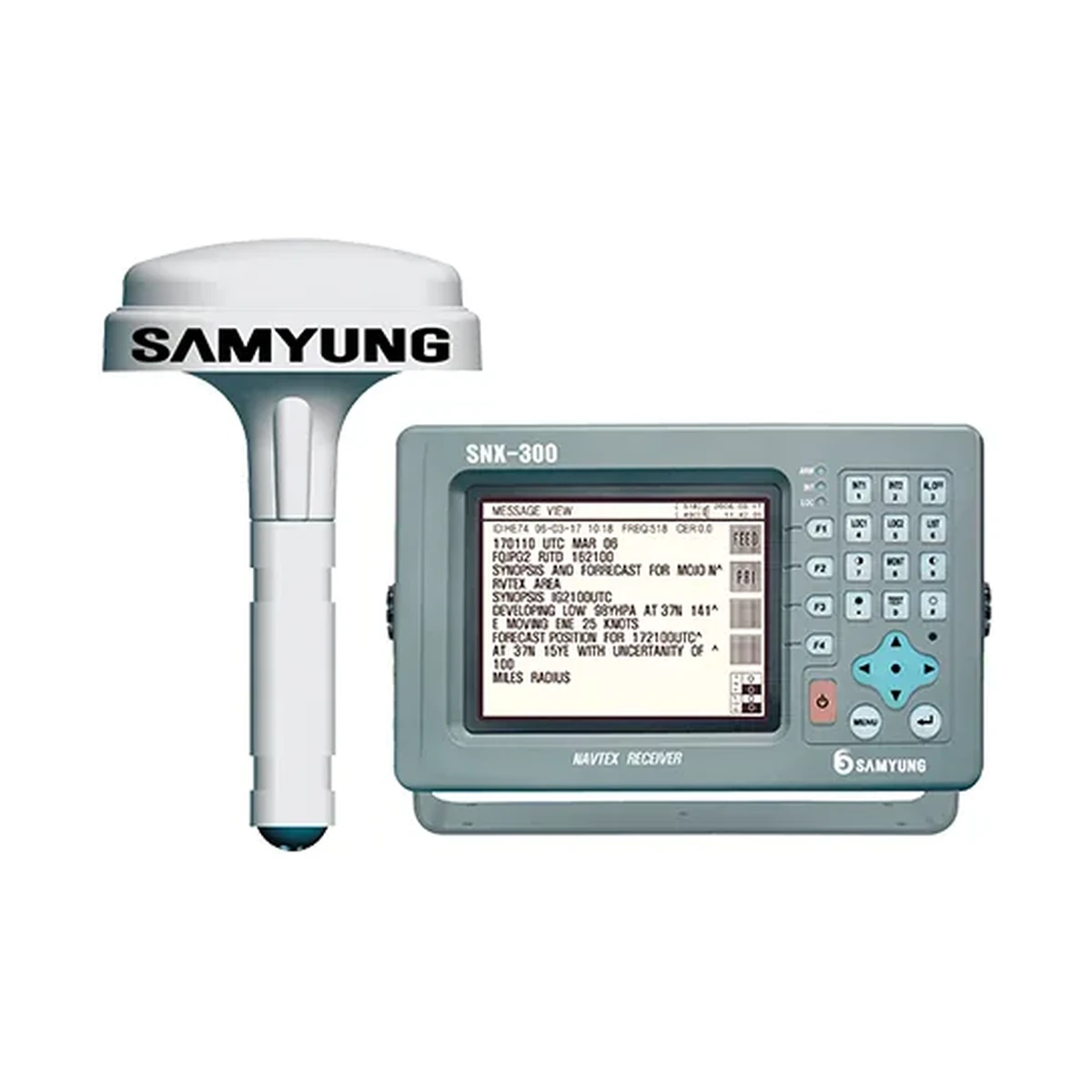
A NAVTEX receiver such as the Samyung SNX-300 monitors two dedicated frequencies, 518 kHz for international messages in English and 490 kHz for messages in a national language, receiving and decoding text broadcasts transmitted from coastal NAVTEX stations at scheduled intervals. The SNX-300 stores up to 72 hours of received messages and includes a built-in thermal printer alongside its 5.6-inch LCD display, so messages are available both as a printed record and on screen without requiring a separate PC or software.
Why NAVTEX still matters alongside satellite systems
Satellite-based safety information services exist and have grown more capable, but NAVTEX's core advantage remains its simplicity: no subscription cost, no satellite antenna to install and maintain, and no dependency on a service provider's ongoing commercial availability. It is also automatic in a genuinely low-effort sense, since a receiver left running requires no operator interaction to capture a broadcast, which matters on a vessel where bridge attention is a limited resource. This is precisely why NAVTEX remains part of the GMDSS framework rather than having been superseded by satellite alternatives.
Coverage and its limits
NAVTEX coverage is provided by a network of coastal transmitting stations and, like any MF broadcast, is bounded by range, generally effective to a few hundred nautical miles from the transmitting station depending on conditions. This makes it well suited to coastal and near-offshore operation but not a substitute for the longer-range safety information services relevant to genuinely ocean-going voyages far from any NAVTEX coverage area, where other elements of a vessel's GMDSS fit take over that role.
What a NAVTEX receiver requires from a vessel
- No licensing burden beyond the vessel's general radio station licensing, since NAVTEX is a receive-only service requiring no transmission from the vessel itself.
- Power and a suitable MF antenna, generally shared with or sited near the vessel's other MF equipment.
- Periodic paper replacement for a thermal-printing model such as the SNX-300, a small but genuine consumable to keep stocked.
- No ongoing subscription or service fee, unlike satellite-delivered safety information services.
Where NAVTEX fits in a vessel's overall GMDSS fit
NAVTEX is typically one part of a broader GMDSS installation rather than a standalone solution, working alongside the VHF, MF/HF DSC and survival craft equipment covered elsewhere in this series. For a vessel operating within coastal NAVTEX coverage, it provides a genuinely low-maintenance, no-subscription channel for exactly the kind of safety information, gale warnings, navigational hazards, search and rescue broadcasts, that a bridge team needs to know about without having to actively request it. ASPL supplies the Samyung NAVTEX range and can advise on where it fits within a specific vessel's GMDSS carriage requirement.