
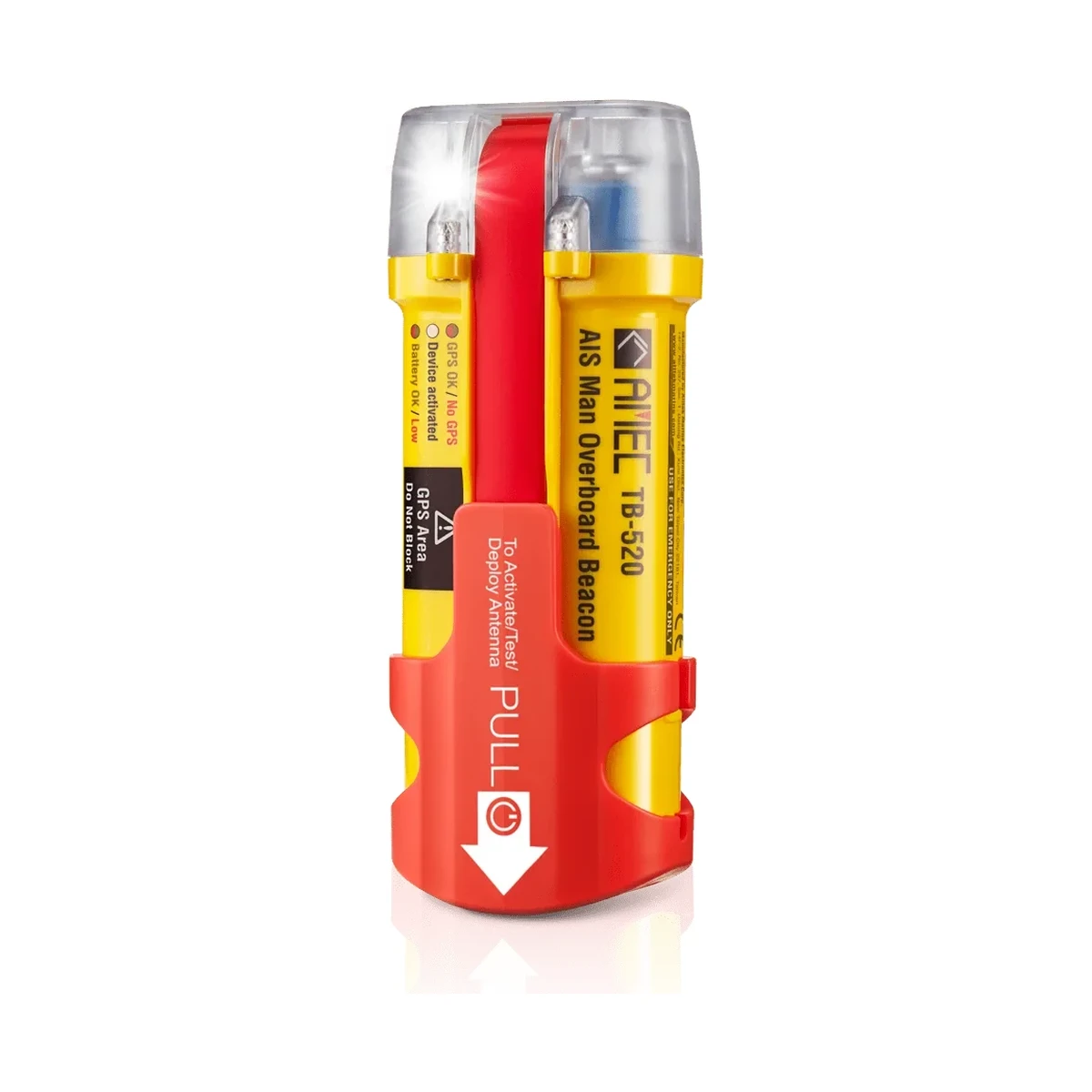
Recovering a person from the water is a navigation problem before it is anything else. A head in a seaway is small, low and quickly lost from view, and the vessel that lost them is usually turning, decelerating and short of hands. An AIS man overboard beacon addresses precisely that: it puts the casualty on the AIS display as a position that updates, so the search becomes steering to a bearing and range rather than scanning the horizon.
How an AIS MOB beacon works
The device is a miniature AIS transmitter with its own GNSS receiver. Once activated it acquires a position and begins transmitting on the two AIS channels, 161.975 MHz and 162.025 MHz, sending position reports and a safety-related message that identifies the transmission as a man overboard alert. Any AIS receiver or transponder within VHF range picks it up and plots it, usually with a distinct icon and an audible alarm.
The AMEC TB520 is a representative example. It pairs a 72-channel GPS receiver with a 2 W VHF AIS transmitter, sending Message 1 position reports and Message 14 MOB alerts once a minute with position accuracy better than 2.0 m using SBAS or 2.5 m autonomous. It is IP68 waterproof, triggers either manually or automatically through a water immersion sensor, carries a high-beam SOS LED rated above 35 lumens, and runs for a typical 72 hours on a primary lithium battery with a five-year storage life. It measures 132 by 52 by 40 mm and weighs 160 g, small enough to live permanently in a lifejacket.
Activation matters as much as transmission. A beacon that has to be found and switched on by a person already in the water, in the dark, in cold, is far less reliable than one that fires automatically on immersion or when the lifejacket inflates. Automatic activation is the feature to look for.
What it is not
An AIS MOB beacon is a short-range, local device. It reaches AIS receivers within VHF line of sight, which in practice means the vessel the casualty fell from and any traffic nearby. It does not reach a satellite, it does not alert a rescue coordination centre, and it does not replace an EPIRB or a personal locator beacon on 406 MHz. The two solve different problems: the AIS beacon solves recovery by the vessel you just left, the 406 MHz beacon solves rescue by an organised response when nobody is nearby.
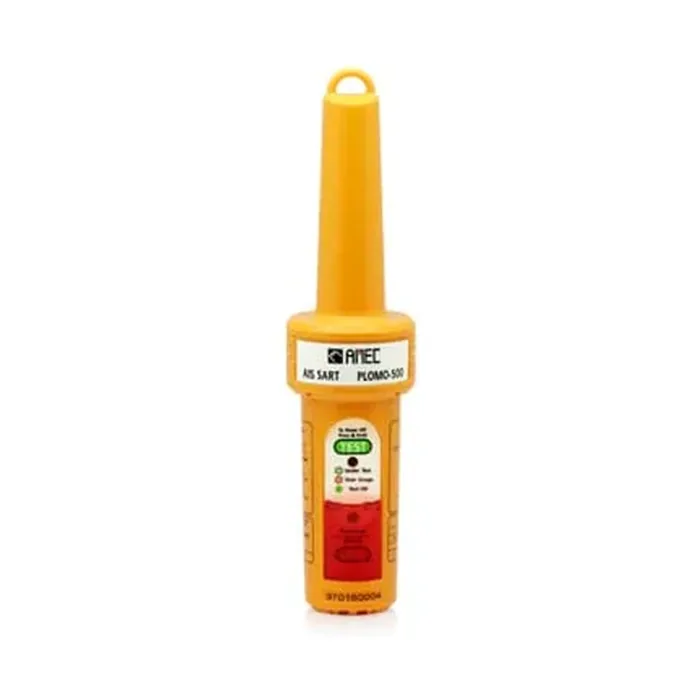
It is also distinct from an AIS SART, which is a vessel-level search and rescue transponder carried in liferafts and survival craft rather than on a person. The AMEC Plomo 500 is that kind of device: a floating unit transmitting Message 1 and Message 14 at 1 W EIRP, with a 72-channel GPS receiver, a yellow buoyant housing rated for immersion to 10 m, a pole extending to 1050 mm for visibility, a replaceable primary lithium battery giving a minimum of 96 hours of operation, and certification to IEC 61097-14, IEC 60945 and ITU-R M.1371-5 along with IMO Resolution MSC.246(83). A SART is survival-craft equipment. An MOB beacon is personal equipment.
Your own AIS has to be able to see it
The most common failure in this chain has nothing to do with the beacon. AIS MOB and SART transmissions use message types and identity ranges that older or simpler AIS equipment may receive but not usefully flag, showing them as an ordinary target or, worse, filtering them out. Handling them properly is a software feature.
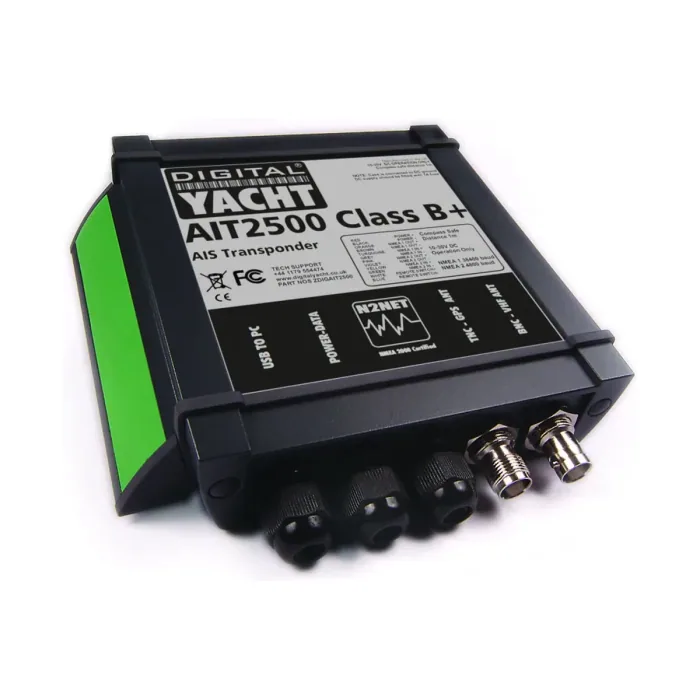
Equipment built with this in mind states it. The Digital Yacht AIT2500 offers an AIS SART alarm specifically described as suited to personal AIS MOB devices, and the Digital Yacht CLA2000 Class A transponder includes optimised software for detecting AIS SART and MOB devices with a dedicated icon for that class of target. If a vessel is issuing MOB beacons to its crew, the bridge equipment should be checked to confirm it alarms on them, ideally by testing rather than by reading the brochure.
Who should carry one
- Crew working on deck at night or in heavy weather on any vessel where recovery would depend on the vessel itself rather than outside assistance.
- Fishing crews, where working deck space is limited, gear is being handled over the side, and the boat may be operating short-handed.
- Offshore and delivery crews on passage, where the nearest other vessel may be hours away and self-recovery is the only realistic option.
- Pilots, survey teams and anyone routinely transferring between vessels at sea.
- Single-handed operators, with the caveat that a beacon with nobody aboard to respond relies entirely on nearby traffic hearing it.
The sensible fit-out on a working vessel is layered: an MOB beacon on each lifejacket for immediate local recovery, an AIS SART in the survival craft, and a 406 MHz EPIRB for the case where the vessel itself is lost. Each covers a scenario the others do not.
ASPL supplies AIS MOB beacons, AIS SARTs, transponders and GMDSS equipment for commercial vessels and fishing fleets, including the bridge-side equipment that has to receive and alarm on them.