
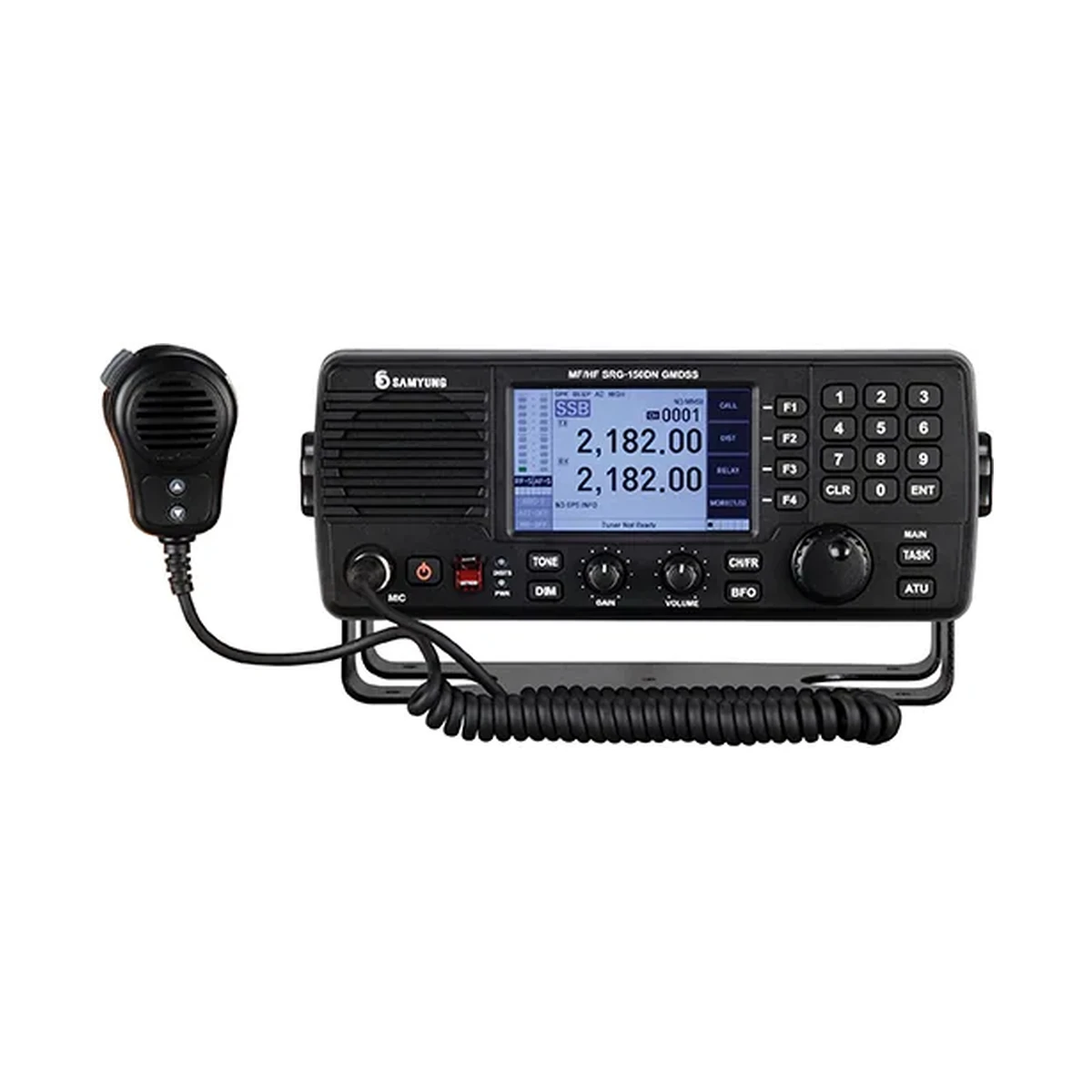
A GMDSS radio station is usually described by the boxes on the console rather than by what those boxes do, which makes it hard for an owner to work out what is actually being bought. The Samyung SRG-150DN is a useful example to unpack, because it carries three distinct functions in one set, and each of them exists to satisfy a different part of the distress and safety system.
The radiotelephone
At its base the SRG-150DN is an MF/HF single sideband radiotelephone. It transmits from 1.6 MHz to 27.5 MHz and receives from 500 kHz to 29.9999 MHz in 10 Hz steps, with the ITU channels plus 300 memory channels, and puts out 150 W on J3E and J2B emissions. That covers the marine MF and HF bands used for long range voice work, which, as ionospheric propagation allows, reaches far beyond anything VHF can do. Communication is simplex and semi duplex, and the set runs from a 24 V DC supply drawing up to 15 A on transmit.
The DSC function
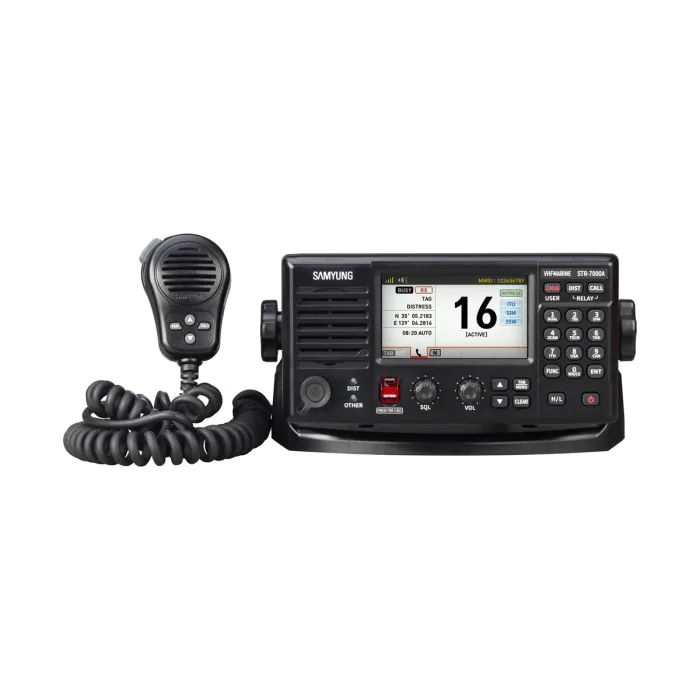
The second function is digital selective calling. Rather than an operator listening on a distress frequency hoping to hear a voice, DSC sends a short data burst carrying the vessel's identity and, where position data is supplied, its position and the nature of the distress. Receiving stations decode it automatically and alarm.
For this to work at sea, someone has to be listening on every distress frequency continuously, and that is what a dedicated DSC watch keeping receiver does. The SRG-150DN watch keeps on 2187.5, 4207.5, 6312, 8414.5, 12577 and 16804.5 kHz, the MF and HF distress and calling frequencies, using F1B emission with frequency shift keying at 1700 Hz plus or minus 85 Hz. The set also carries the two tone distress signal at 1300 Hz and 2100 Hz. The point of the six frequency watch is that ionospheric conditions decide which band will actually propagate at a given hour, so the system has to cover several simultaneously.
NBDP, the telex side
The third function is narrow band direct printing, the maritime telex service. NBDP sends text rather than voice over the same HF path, which matters because a text message can get through conditions that would make speech unintelligible, and because it produces a printed record. The SRG-150DN supports the standard NBDP modes, ARQ for an acknowledged link between two stations and CFEC and SFEC for forward error correction broadcasts, with 16 MB of message memory on board.
Where Inmarsat-C fits, and what it is not
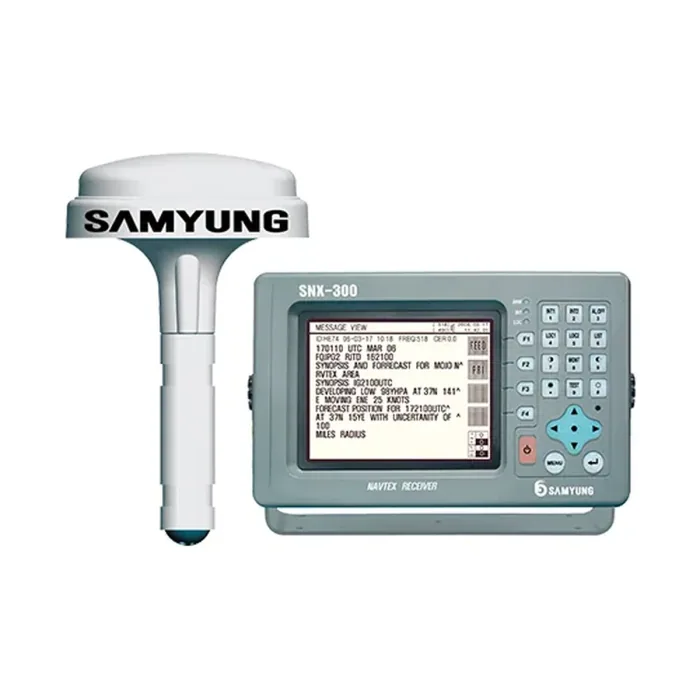
Owners often hear MF/HF DSC and Inmarsat-C spoken of in the same breath, because both appear in GMDSS carriage requirements and both can carry distress alerting and safety messages. They are entirely different systems. Inmarsat-C is a satellite terminal: it uses a geostationary satellite network, provides store and forward messaging and distress alerting, and is the usual carrier for Enhanced Group Call and SafetyNET maritime safety information in areas outside NAVTEX coverage. The SRG-150DN is not a satellite terminal. It is a terrestrial MF/HF radio, and its distress alerting reaches coast stations and other ships over the air rather than through a satellite. On many vessels the two coexist, with the radio covering the terrestrial requirement and the satellite terminal covering the areas and services the radio cannot.
Practical points for an installation
- Supply: 24 V DC plus or minus 15 percent, with 15 A available on transmit and roughly 2 A at receive.
- Environment: rated from -15 C to +55 C at up to 95 percent humidity, so console siting still needs sensible ventilation.
- Antenna and ground: an HF set at 150 W into 50 ohms needs a proper antenna system, tuner and ground arrangement to make its rated output useful.
- Position input: DSC alerts are only fully useful when the radio is fed current position from the vessel's GNSS.
- Operator certification: GMDSS equipment classes generally require a certified radio operator, and in India the commercial radio operator certificate of proficiency for GMDSS is issued by the WPC Wing of the Department of Telecommunications.
ASPL supplies GMDSS, marine VHF and HF equipment for commercial vessels and fishing fleets across India and handles installation, commissioning, bridge interfacing and handover, with in house repair and a nationwide collection network behind it.