
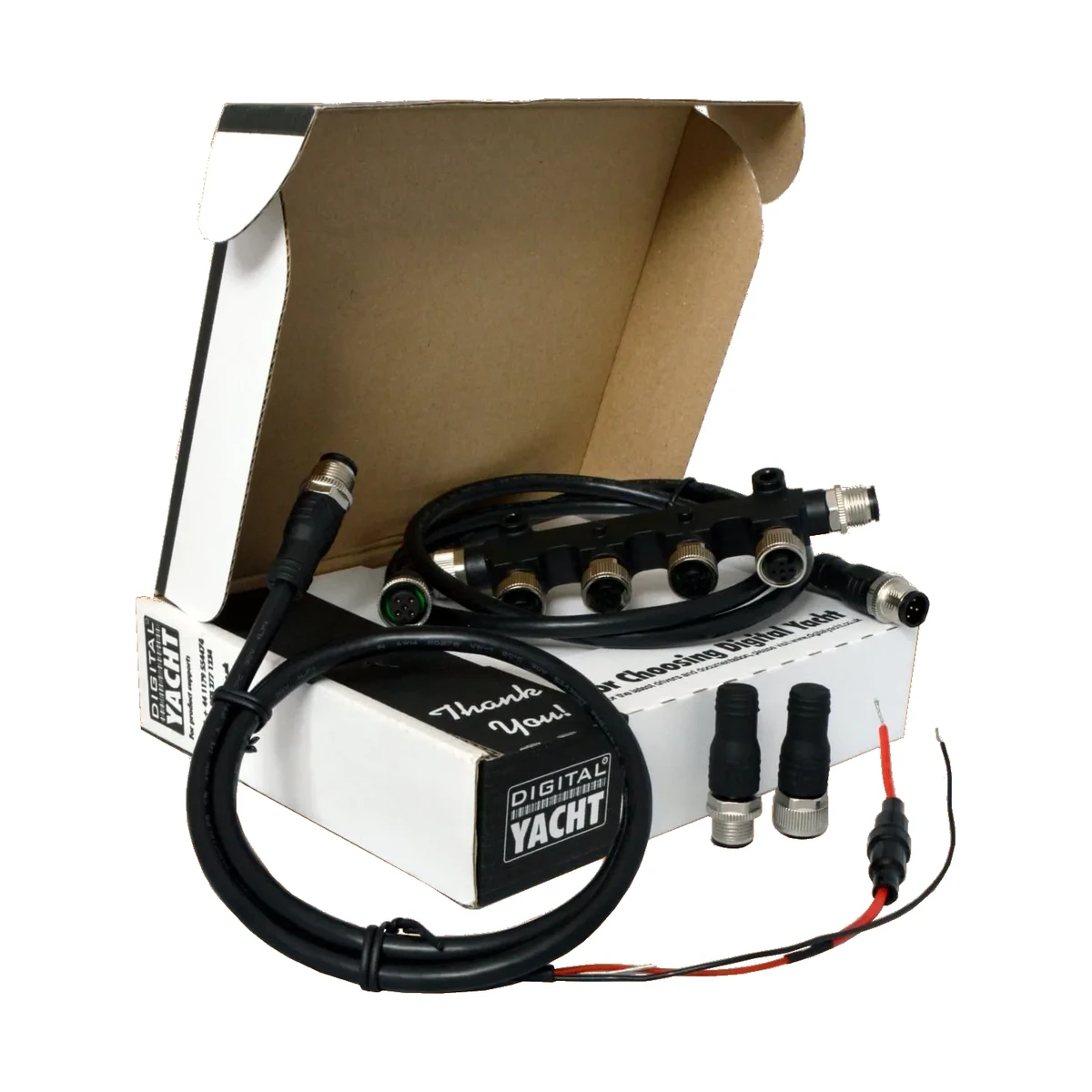
A boat with one chartplotter is simple. A boat with a plotter at the helm, a repeater at the inside station, an AIS transponder, a depth and wind instrument and an autopilot is a network, and it needs to be planned as one. NMEA 2000 is the standard that most of the marine electronics industry now uses for that job, and understanding its shape makes the difference between an installation that expands cleanly and one that has to be pulled apart every time something is added.
The backbone and drop cable model
NMEA 2000 is not a star topology where everything runs back to the plotter. It is a single trunk, usually called the backbone, that runs through the boat with a terminating resistor at each end. Every device connects to that trunk through a short drop cable off a tee connector, and the trunk also carries the network's own power. The connectors are waterproof throughout, so the physical installation is largely plug and play once the backbone is in place.
The two ends matter. A backbone without terminators at both extremities will behave erratically or not at all, and this is the single most common fault on a self-installed network. Digital Yacht's NMEA 2000 starter kit is built around exactly this structure: a six-way extension block forming a compact backbone, with ports at each end for the terminators and a power cable included, enough to interconnect three devices such as an AIS unit, a plotter and an autopilot. It can be expanded with standard components as the boat grows, and works with all the leading brands.
What travels over the network
Once the backbone exists, every device on it both publishes and consumes data. The GNSS receiver inside a chartplotter or an AIS transponder publishes position; a heading sensor publishes heading; depth, speed, wind and engine data all appear on the same wire. Any display can then show any of it. That is why a dedicated instrument display such as the Garmin GMI 20 needs nothing but an NMEA 2000 connection to show navigation, engine and environmental data, and why an AIS transponder like the AMEC B620 or the AMEC WideLink B650 can put targets onto a plotter through a single NMEA 2000 drop with a load equivalency of 1.
Budgeting power and load
Every device draws current from the network, expressed as a load equivalency number, or LEN, where one LEN is 50 mA. The Garmin SteadyCast heading sensor is LEN 2, the GMI 20 is LEN 3, and a Class B AIS transponder is typically LEN 1. Add up the LEN figures of everything on the backbone before you power it from a single point, and site the power injection point somewhere near the electrical centre of the trunk rather than at one end. This is the arithmetic that gets skipped and then causes intermittent dropouts on a busy network.
Where NMEA 0183 still comes in
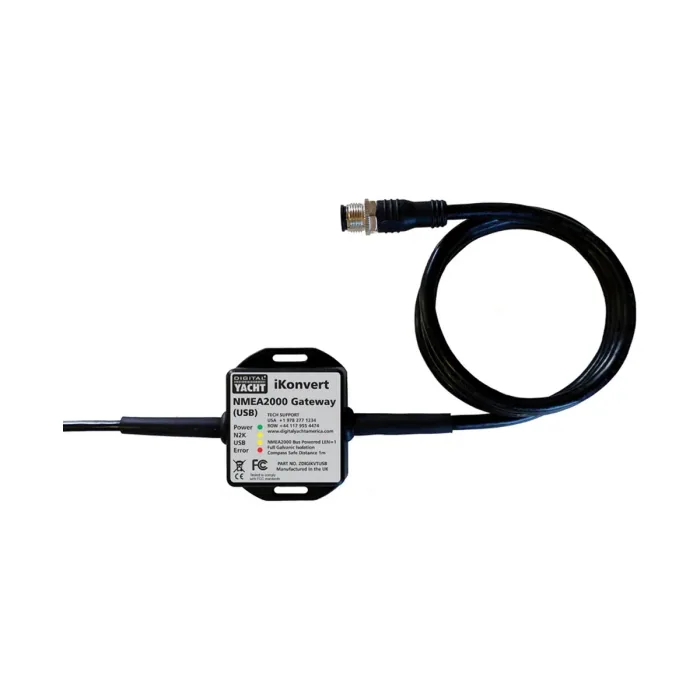
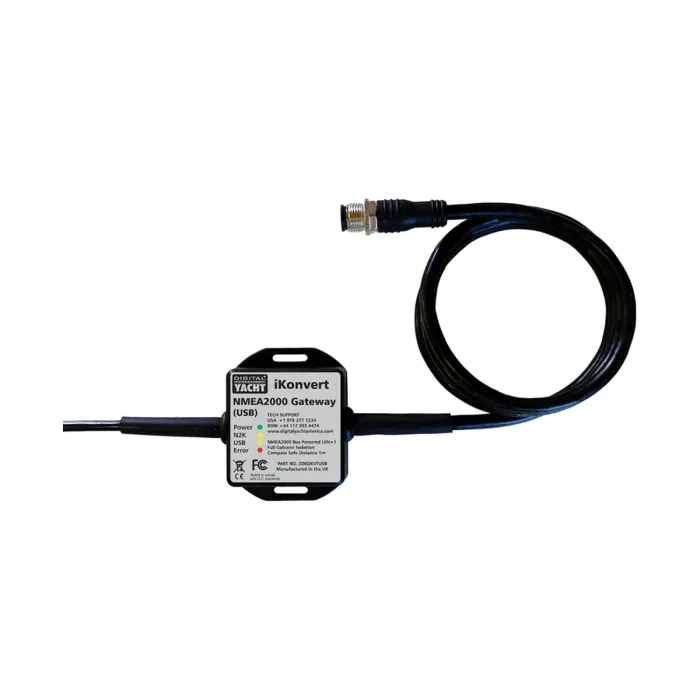
Plenty of perfectly serviceable equipment predates NMEA 2000 or was never built for it. NMEA 0183 is a point to point serial protocol, one talker to one or more listeners, which is why boats accumulating several 0183 devices end up needing a multiplexer. Mixed networks are normal, and the fix is a gateway. Digital Yacht's iKonvert converts bi-directionally between NMEA 2000 and NMEA 0183, so a new NMEA 2000 multi-function display can still send GPS and navigation data to an older 0183 VHF or autopilot, and legacy 0183 sensors can put their data onto the newer network. It uses DIP-selected modes, including heading, sounder, AIS, GPS, wind and instrument modes plus an all-data gateway mode, so the conversions and baud rate are set once at installation.
Note that many helm units carry both. The Garmin GPSMAP 923xsv has one NMEA 2000 port alongside separate NMEA 0183 input and output ports, a J1939 engine port and a Garmin Marine Network port. The Garmin Marine Network is an Ethernet layer used for high bandwidth traffic such as radar and sonar sharing between displays, and it sits alongside NMEA 2000 rather than replacing it. If you want two Garmin displays sharing one radar picture, that is the Marine Network doing the work, while position, depth and wind still travel over NMEA 2000.
Getting data onto phones and tablets
NMEA 2000 does not put anything on a tablet by itself. A wireless gateway does. The Digital Yacht WLN30 multiplexes three NMEA 0183 inputs and creates a password-protected onboard Wi-Fi network so compatible charting apps can display live GPS, AIS and instrument data, and the LanLink gateway does the equivalent job onto a wired Ethernet network over TCP/IP or UDP, supporting up to five connected devices.
Planning the install
Run the backbone first and route it where it can be reached later, then hang devices off it. Terminate both ends. Add up the LEN. Decide early which protocol each existing device speaks so you know how many gateways you need before you start cutting cable. ASPL handles NMEA 0183 and NMEA 2000 interfacing between navigation, AIS, autopilot and charting systems as part of its commercial marine work, including commissioning and operator handover.