
Two standards, doing the same job differently
An AIS transponder receives target data and then has to hand it to something that can draw it: a chartplotter, a multifunction display, a PC running charting software, or a tablet. That handover happens over one of two NMEA standards, and which one you are dealing with determines everything about the installation.
NMEA 0183, standardised internationally as IEC 61162-1, is a serial point to point protocol. One talker sends text sentences down a wire pair to one or more listeners at a fixed baud rate. The general instrument rate is 4,800 bps, but AIS ports run at 38,400 bps because AIS produces far more data than a depth sounder does. The sentences are human readable: GGA for position, VTG for course and speed, VDM and VDO for AIS target and own vessel messages.
NMEA 2000, standardised as IEC 61162-3, replaces that wiring model with a shared CAN bus backbone. A single cable runs the length of the vessel, every device taps into it with a short drop cable, and any device on the bus can both send and receive without being wired directly to anything else. Data is carried as numbered Parameter Group Numbers rather than text sentences.
Which one is your AIS speaking
Most current AIS transponders speak both, which makes the decision easier than it used to be. The AMEC WideLink B650 provides two NMEA 0183 ports, NMEA 2000 and a USB-C virtual COM port, and the B620S offers the same combination. On the Digital Yacht side, the AIT6000 and the iAISTX Plus both provide NMEA 2000 alongside Wi-Fi output. Older receivers are more likely to be 0183 only, as with the AIS100 Pro, which gives dual NMEA 0183 and USB.
The question then becomes what your display accepts. A recent multifunction display will usually have an NMEA 2000 connector and expect to be fed that way. An older chartplotter may only have a single NMEA 0183 input, and if the GPS is already occupying it, that input is spoken for.
When you need a gateway
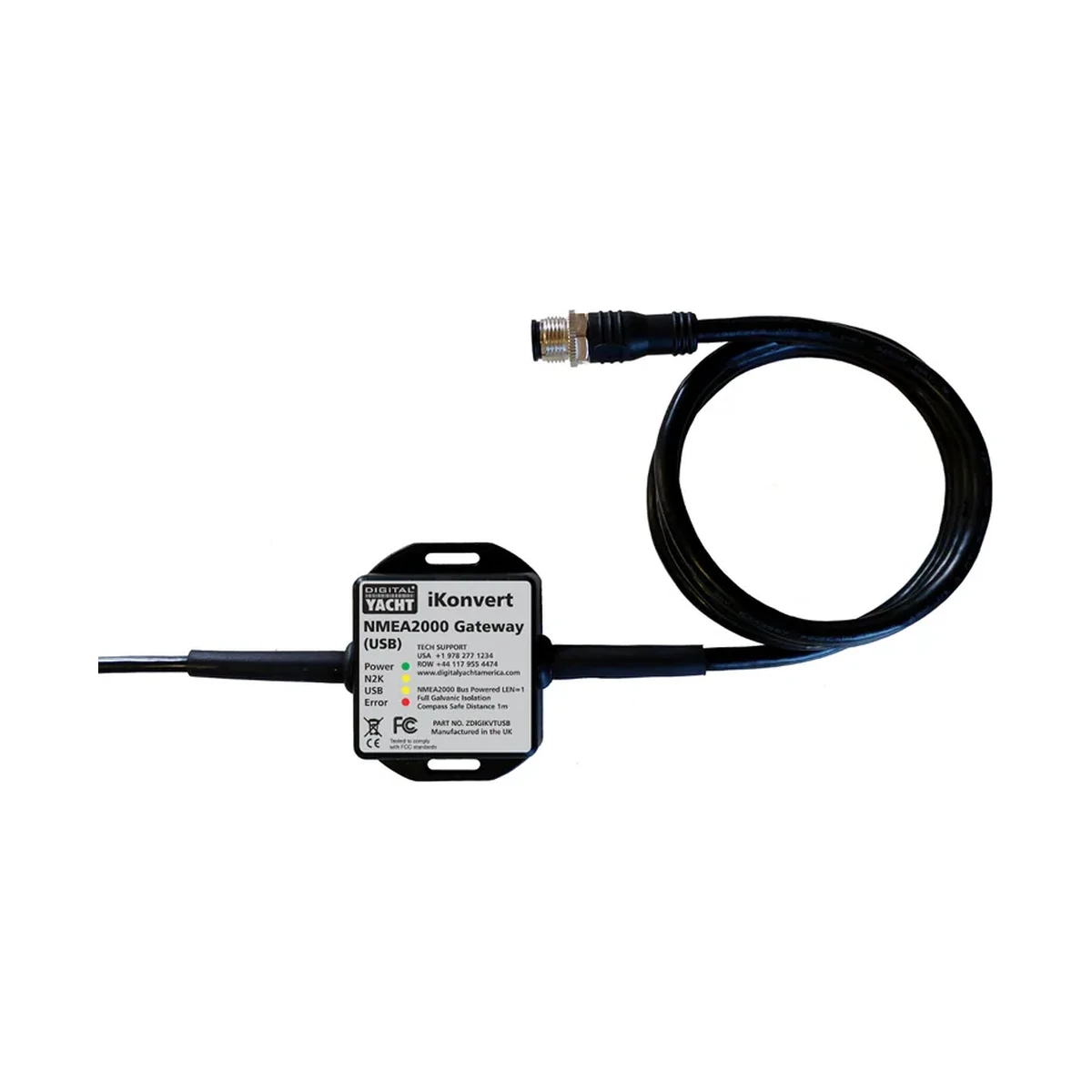
If the AIS and the display speak different protocols, something has to translate. A gateway such as the Digital Yacht iKonvert converts bidirectionally between NMEA 2000 and NMEA 0183, so a legacy 0183 sensor can appear on a modern backbone or a new NMEA 2000 multifunction display can feed position and navigation data back to an older 0183 VHF or autopilot. Mode selection on the iKonvert is by DIP switches inside the housing, which keeps the configuration deliberate rather than accidental.
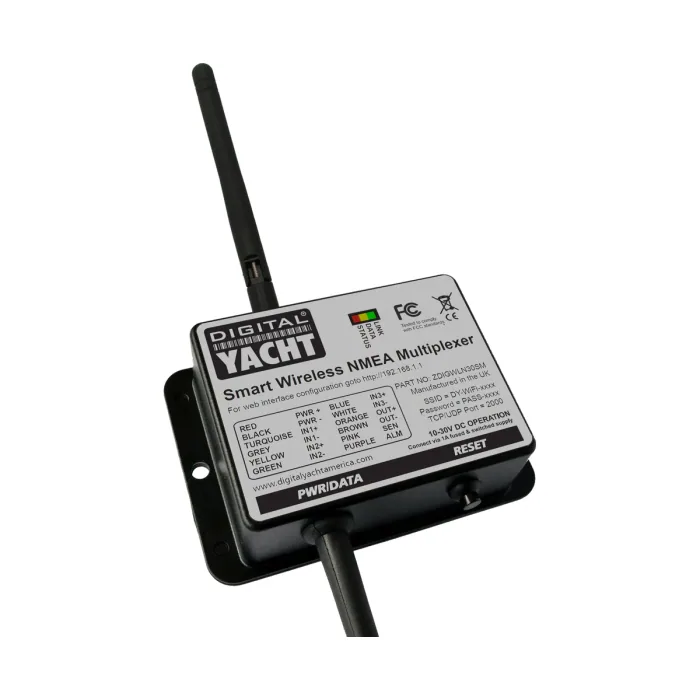
If the problem is instead that you have several NMEA 0183 talkers and one listener input, you need a multiplexer, not a gateway. Connecting two talkers to the same listener input corrupts both data streams. A multiplexer merges them properly. The Digital Yacht WLN30 Smart takes three NMEA 0183 inputs and provides one output, with each port selectable between 4,800 and 38,400 baud through a browser interface, and simultaneously puts the combined data onto a password protected onboard Wi-Fi network.
The wireless route
Getting AIS onto a tablet is often easier than getting it onto a fixed display. A transponder with built in Wi-Fi, or a wireless multiplexer such as the WLN30, streams the same NMEA data over TCP or UDP to apps running on phones and tablets. The iAISTX Plus supports up to seven connected devices over UDP and TCP/IP, with an internal antenna that typically covers a boat up to 60 feet. This adds a display layer without running new cable, which matters most on vessels where the helm, the saloon and the flybridge all want the same picture. It does not replace a wired feed to the primary navigation display, which should not depend on a Wi-Fi link.
Practical installation points
- Match the baud rate at both ends. An AIS output at 38,400 into a listener expecting 4,800 produces nothing usable.
- Respect polarity on NMEA 0183. The standard uses differential signalling, and swapped A and B conductors are a common cause of a silent port.
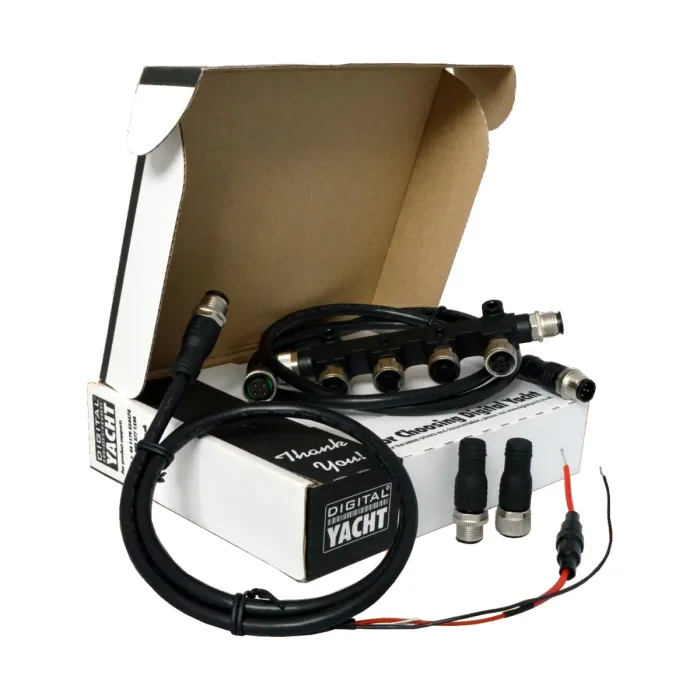
- Terminate an NMEA 2000 backbone with a resistor at each of its two physical ends, no more and no fewer.
- Check the backbone's power budget before adding devices. The AMEC transponders declare a load equivalency number of 1, and every device on the bus draws from the same supply.
- Keep drop cables short and leave a spare tee or two for later additions.
Getting it interfaced
ASPL supplies and integrates the full Digital Yacht and AMEC ranges in India, including NMEA 0183 and NMEA 2000 interfacing between navigation, AIS, autopilot and charting systems, and hands the installation over commissioned rather than simply delivered.