
Digital Selective Calling, DSC, is the standard for sending short, automated digital alerts on marine VHF, MF and HF radio: distress, urgency, safety or routine, addressed to one vessel or all of them, without anyone having to be listening at the moment it arrives. It is the automated backbone of GMDSS, and in a distress situation it does in under a second what a spoken mayday call takes a frightened person a minute to get out, assuming they get it out at all.
What is DSC used for?
Four things: distress alerting, urgency calls, safety calls, and routine individual or all-ships calling. Distress is the one crews think about, but DSC's everyday job is closer to a phone system, letting one radio "dial" another vessel's MMSI directly and propose a working channel, instead of everyone sharing channel 16 and hoping the right ears are listening.
Channel 70 is not a voice channel
Every DSC-equipped VHF set watches 156.525 MHz, marine channel 70, continuously whenever it is powered. That is DSC's dedicated frequency, and it carries no speech at all. It carries short bursts of data, sent as 16K0G2B emission rather than the 16K0G3E frequency modulation used for voice, and the receiver decodes them and acts on them automatically. This is why a DSC set has to keep a watch on two things at once, channel 70 for data and channel 16 for voice, and why fixed-mount sets are specified with that dual watch built in. It is also why a DSC alert reaches further than an equivalent voice call on the same radio: a narrow-band digital signal, decoded without a squelch fighting it, holds up over a longer range than the analogue voice signal riding the same power output.
What actually happens when the distress button is pressed
The sequence is short and worth knowing by heart. The operator lifts the guarded distress cover and holds the button, typically for three to five seconds, so that a knock or a sleeve cannot trigger it. The radio then transmits a distress alert on channel 70 containing three things: the vessel's nine-digit Maritime Mobile Service Identity, the nature of the distress if one has been selected, and the vessel's position with the time it was valid.
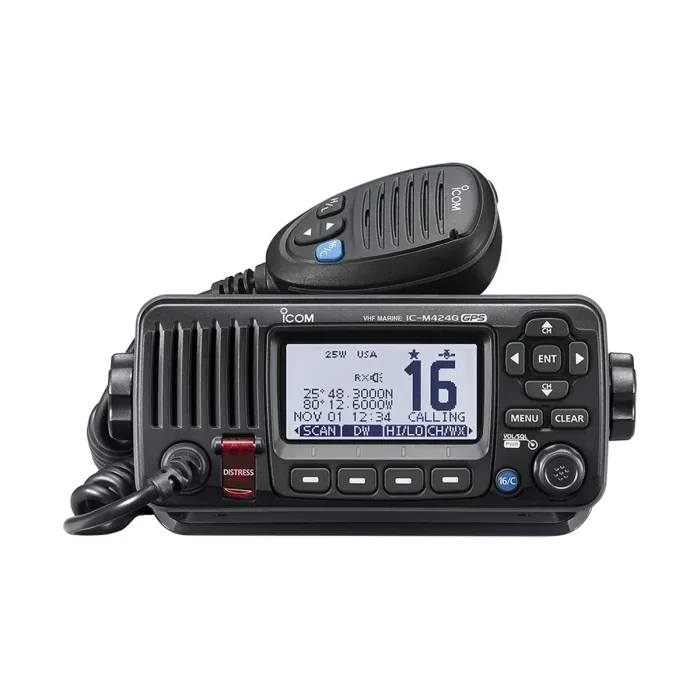
That last item is the reason DSC installation practice matters so much. A DSC alert without a position tells a rescue coordination centre that someone within VHF range is in trouble and nothing more. The position comes either from a GNSS feed wired into the radio over NMEA, which is why fixed sets list input sentences such as RMC, GGA, GNS and GLL, or from an internal receiver in sets built with one, such as the Icom IC-M424G or the handheld IC-M94D. If neither is present the position has to be keyed in by hand, and it will be as stale as the last time somebody remembered to do it.
Having transmitted, the radio switches itself to channel 16 and waits. Coast stations and other vessels in range receive the alert, their radios sound an alarm and display the calling vessel's identity and position, and the exchange then continues by voice on channel 16 in the normal way. The digital alert does not replace the mayday call. It precedes it, and it means that even if nobody manages to speak, the identity and position are already out.
The MMSI is the whole system
A DSC radio is useless until its MMSI is programmed, and the number is issued to the vessel by the national administration, not by the equipment supplier. Two practical consequences follow. First, most sets allow the MMSI to be entered only a limited number of times, sometimes once, precisely so that the identity stays tied to the vessel. Second, if a radio is sold on or the vessel is renamed or re-registered, the registration record has to be updated, or a rescue centre will be handed the wrong owner, the wrong emergency contact and possibly the wrong vessel description at the worst possible moment.
Class A DSC vs Class D DSC
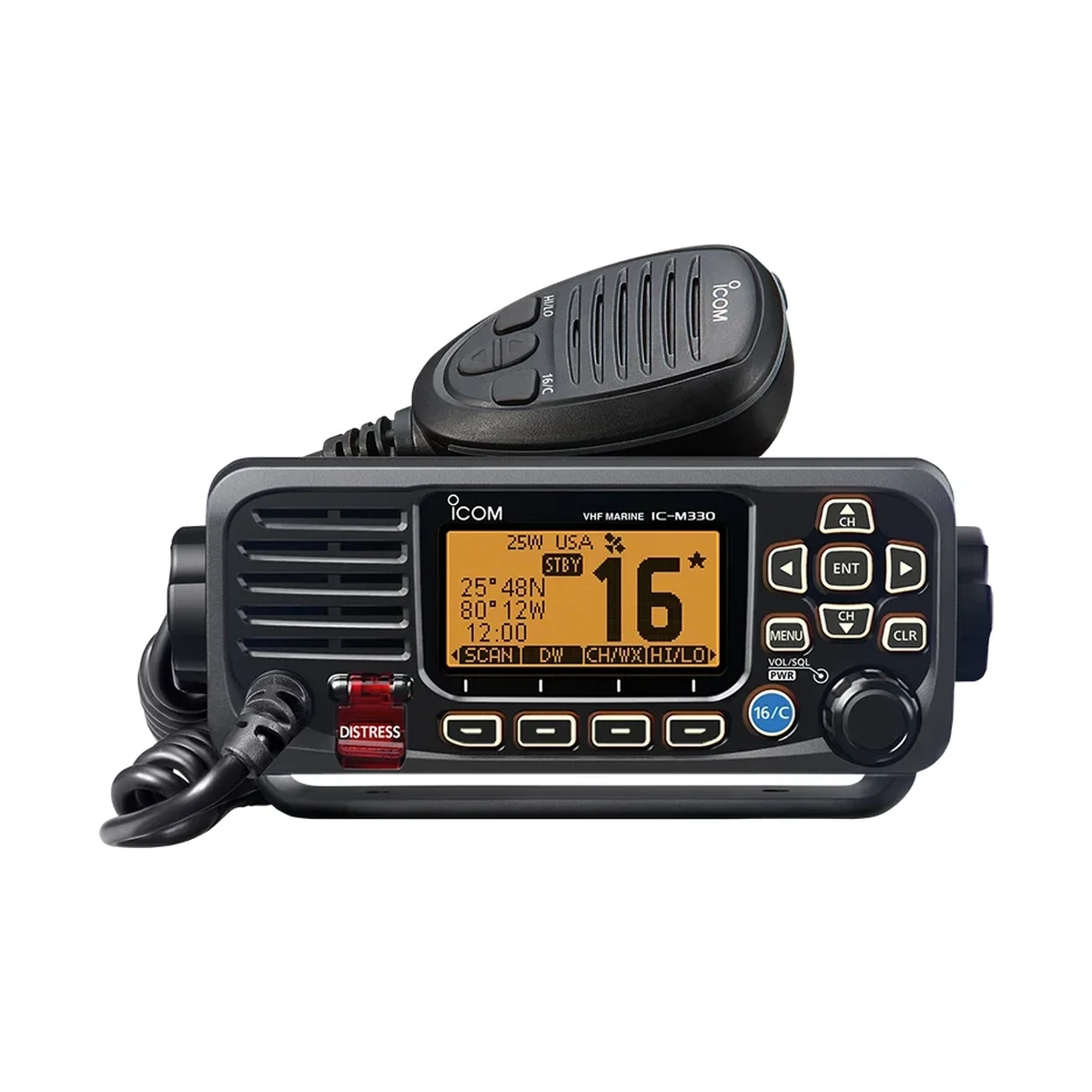
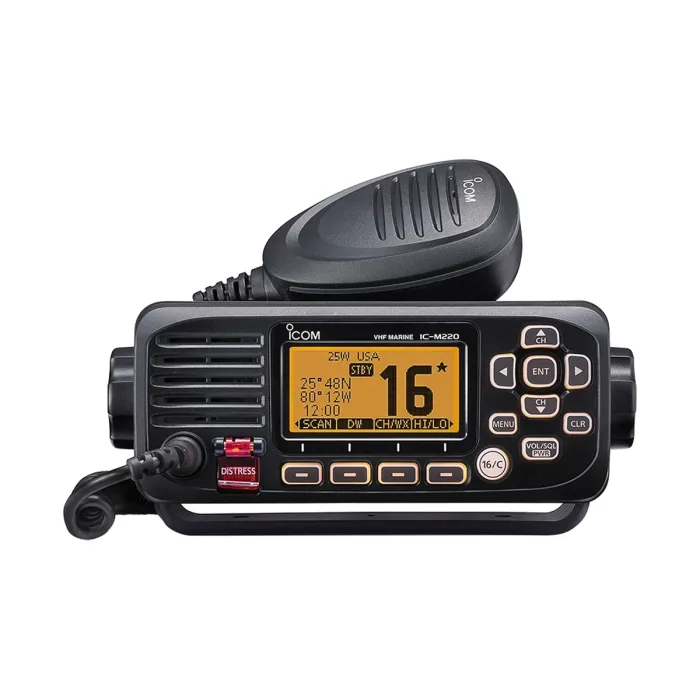
The two are not tiers of the same thing, they cover different vessels. Class A DSC, as fitted to GMDSS installations such as the Icom GM600 and the Samyung STR-7000A, supports the full set of call types required of a SOLAS ship, distress, urgency, safety and routine, on MF, HF and VHF as fitted. Class D DSC, found in commercial and leisure fixed sets such as the Icom IC-M330 and IC-M220, covers the same distress and routine calling on VHF for vessels outside the SOLAS carriage regime, a coastal fishing boat or a leisure craft rather than a SOLAS-convention ship. A vessel does not choose between them for feature reasons. It is fitted with whichever class its carriage regime and equipment actually require.
Three things to check on your own set
- Is the MMSI programmed, and is it the vessel's own current number?
- Does the radio have a live position, from an internal GNSS receiver or an NMEA feed, and does the display confirm it?
- Does the crew know where the distress cover is and how long to hold the button, without having to look for it?
None of that costs anything to verify, and all three are the difference between an alert that starts a search and an alert that starts a question.
Common questions about DSC
What is the purpose of Digital Selective Calling?
To get another radio's attention, or every radio's attention, automatically and on a channel dedicated to that job alone, so an alert does not depend on the right person listening to the right channel at the right moment. Distress alerting is the highest-stakes use of that mechanism, not the only one.
Is DSC the same as a mayday call?
No. A DSC distress alert is the digital trigger that precedes a mayday, sent automatically in under a second with the vessel's identity and position attached. The voice mayday that follows on channel 16 is still how the actual emergency gets described. DSC gets the alert out even if the voice call that follows is garbled, delayed, or never happens at all.
Does DSC work without GPS?
The alert still transmits, but without a GNSS feed or internal receiver, the position field is whatever was last keyed in by hand, which on most vessels means it is wrong. A DSC set with no live position defeats the main reason the position field exists.