
A sailing boat's instrument fit answers three separate questions. Where is the wind and how hard is it blowing. How fast is the boat moving through the water. And which way is the pressure going. The first two drive trim and tactics minute by minute, the third gives you a day or two of warning about what is coming. On a modern boat all three arrive at the display over the same NMEA 2000 backbone, which is what makes it possible to combine them into figures no single sensor can produce on its own.
Apparent wind and true wind
A masthead wind transducer only ever measures apparent wind: the airflow over the boat, which is the vector sum of the true wind and the wind created by the boat's own motion. Apparent wind is what the sails feel, so it is the right number for trimming. True wind is what you need for tactics and for deciding whether to reef. Getting from one to the other requires the instrument system to combine the masthead reading with boat speed and heading, which is precisely why these sensors sit on a shared network rather than each feeding its own gauge. A wind transducer alone cannot give you true wind.
The masthead unit
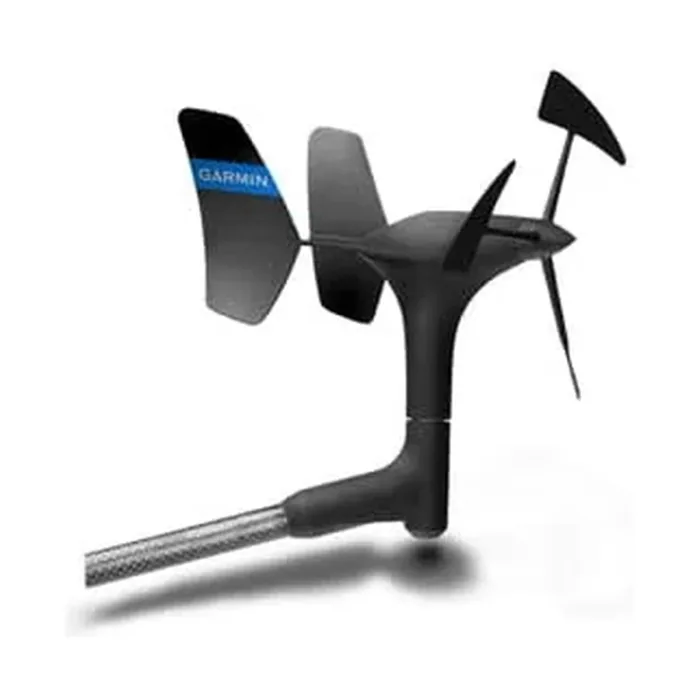
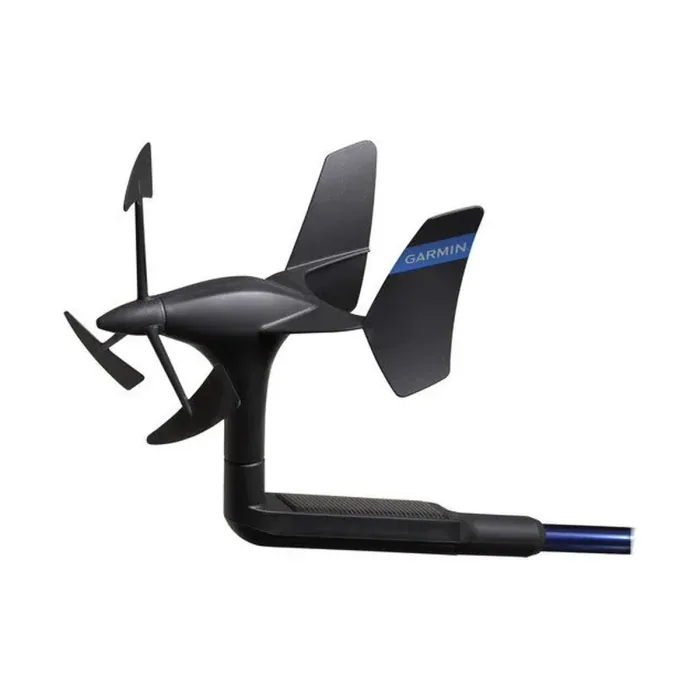
Garmin's gWind range covers the two mounting approaches. The gWind Wired measures wind speed from 0.8 to 90 knots, weighs 260 g mounted, is rated IEC 60529 IPX6 against heavy seas and runs a 25 metre cable down the mast, drawing 0.33 W for the transducer alone or 0.85 W when paired with a Garmin GND 10. The gWind Wireless 2 covers 0.9 to 90 knots at 320 g and sends its data wirelessly, which removes the cable run down the mast entirely. That is a meaningful practical difference on a boat where pulling a new cable means unstepping the rig, though a wired sensor has no batteries or radio link to worry about and its stated operating range, minus 15 to 70 degrees C, is wider than the wireless unit's minus 20 to 50 degrees C.
Digital Yacht's WND100 takes a different route. It outputs NMEA 0183, sending the standard $WIMWV wind sentence at 5 Hz over a 20 metre masthead cable, and is built around Igildur bearings and UV and salt resistant plastics for longevity. Because it speaks 0183, it connects readily to legacy instrument systems and to multi-function displays with a spare 0183 input, which makes it a straightforward replacement when an existing masthead unit has failed but the rest of the system is sound.
Displaying it
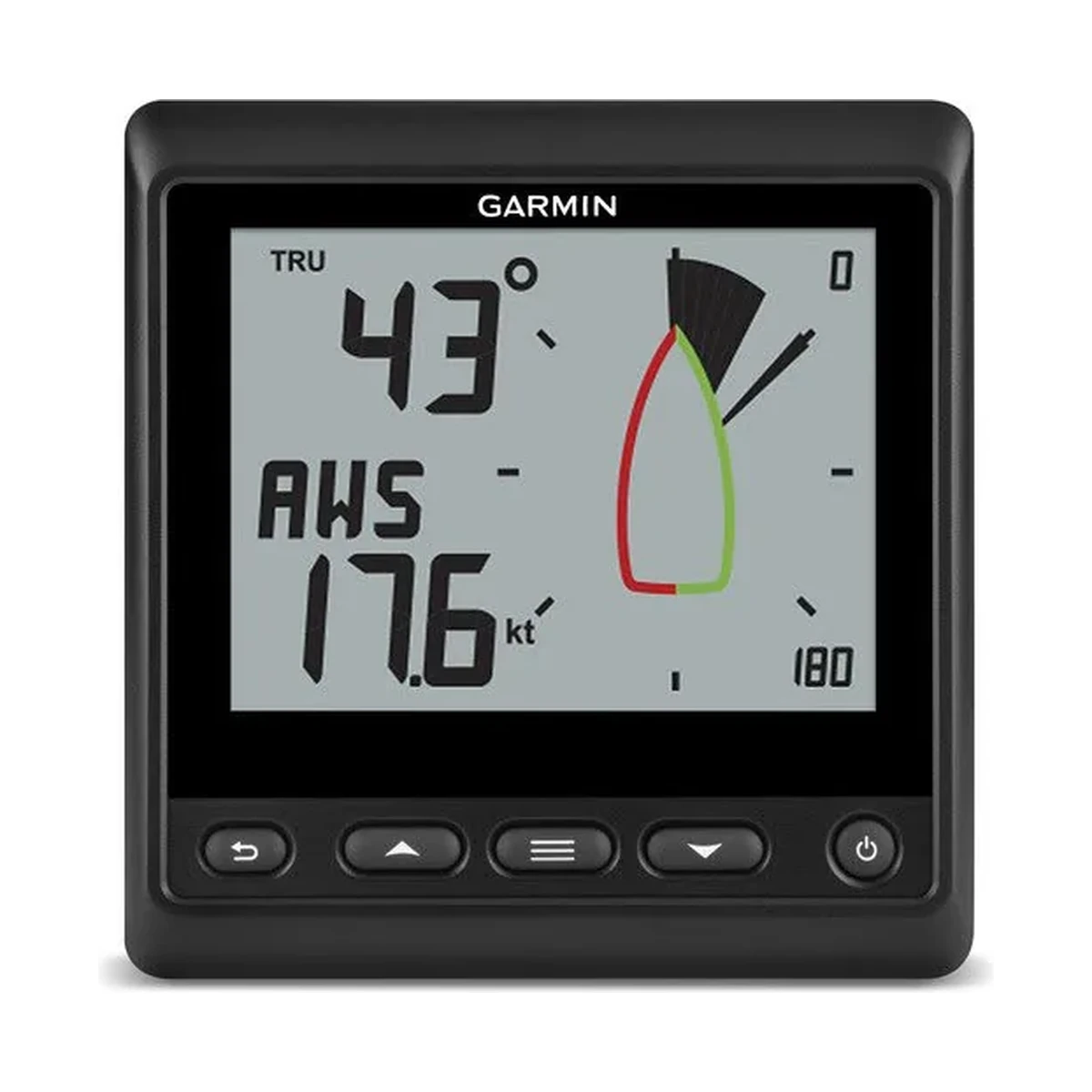
A dedicated wind display earns its panel space because wind angle is read as a picture, not as a number. The Garmin GNX Wind is exactly that: a wind instrument for sailboats in a fully gasketed polycarbonate case with a glass anti-glare lens, IPX7 rated, 110 by 115 by 30 mm, drawing a maximum of 1.35 W over NMEA 2000 with a load equivalency number of 3. For everything else, the GMI 20 is a general-purpose NMEA 2000 instrument display for navigation, engine and environmental data in the same case size and with the same power figures. A common fit is one of each: wind on the dedicated display, and depth, speed, temperature or pressure cycling on the general one.
The barometer
Barometric pressure is the one weather instrument that tells you something about the future rather than the present, and it is the trend that carries the information, not the absolute reading. Digital Yacht's EnviroLink is an NMEA 2000 barometer and weather station measuring pressure across 300 to 1100 hPa with 0.18 Pa resolution, an absolute accuracy of plus or minus 1.0 hPa and a relative accuracy of plus or minus 0.12 hPa, plus ambient temperature from minus 40 to 85 degrees C and relative humidity across the full range. It is self-powered from the network and transmits PGNs 130313 for humidity, 130314 for actual pressure and 130316 for extended temperature. Note which accuracy figure matters here: relative accuracy is the tighter of the two at plus or minus 0.12 hPa, and it is the one that governs how small a pressure change the instrument can resolve, which is what trend watching depends on.
If you want conditions measured in more than one place, NAVLink Blue is a Bluetooth-to-NMEA 2000 interface that brings temperature, humidity and pressure from up to 16 wireless Ruuvi sensors onto the bus, the tags reporting pressure across 500 to 1155 hPa to 1 hPa accuracy.
Speed, depth and the rest of the picture
True wind calculation needs boat speed, and depth is wanted anyway. The Digital Yacht iSeaSense packs cover both: the wireless speed, depth and temperature pack delivers speed from 0.3 to 45 knots at 5 Hz and depth to 100 m at 235 kHz through a standard 2 inch thru-hull, self-powered from the NMEA 2000 backbone, with an integrated Wi-Fi antenna that typically covers a boat up to 20 m. The ISSPK2 variant adds a wind sensor on a 20 m masthead cable drawing 25 mA.
Watch the power budget
Every device on an NMEA 2000 bus draws from a shared power budget, expressed as a load equivalency number where one LEN corresponds to 50 mA. The GNX Wind and the GMI 20 each carry a LEN of 3, or 150 mA at 9 Vdc. Two displays, a wind sensor, a barometer and a speed and depth transducer add up, so total the LEN values of everything on the bus against what the backbone's power supply can deliver before adding the next instrument.