
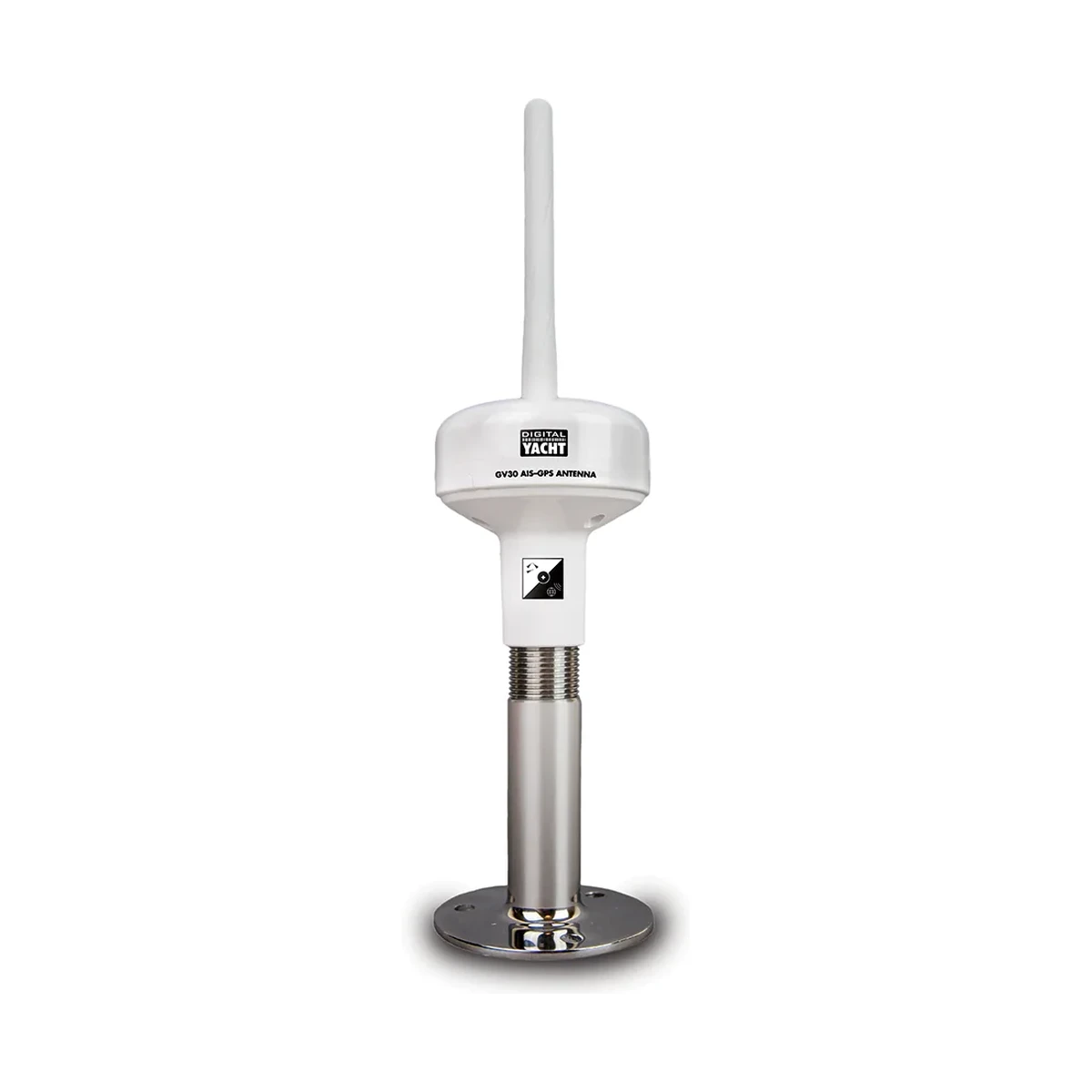
AIS range is a VHF question, not an AIS question
AIS transmits on two dedicated VHF channels, 161.975 MHz and 162.025 MHz. At those frequencies radio propagation is essentially line of sight, with a small amount of atmospheric refraction bending the signal slightly beyond the geometric horizon. That single fact governs everything else. AIS range is not a property of the transponder so much as a property of how high its antenna sits and how high the receiving antenna sits.
The useful approximation is that the radio horizon in nautical miles is roughly 2.2 times the square root of the antenna height in metres, and the total range between two stations is the sum of both horizons. A transponder with its antenna 4 metres above the water has a horizon of about 4.4 nautical miles. Another small vessel at the same height sees the same distance, so the two might exchange positions at around 9 nautical miles. Put one of those antennas 30 metres up on a ship's mast and its horizon extends to about 12 nautical miles, giving a combined range closer to 16. This is why small craft routinely see large ships well before those ships see them.
What the realistic figures look like
- Small vessel to small vessel, both with low antennas: often 5 to 10 nautical miles.
- Small vessel to a large ship or a shore station with a high antenna: commonly 15 to 25 nautical miles.
- A well sited receiver ashore or on a mast: targets out to 20 to 30 nautical miles are typical.
- Ship to ship between two high antennas: 30 nautical miles and beyond is achievable.
Treat these as working expectations rather than specifications. Conditions, antenna quality, cable losses and local terrain all move the numbers.
Where transmit power fits in
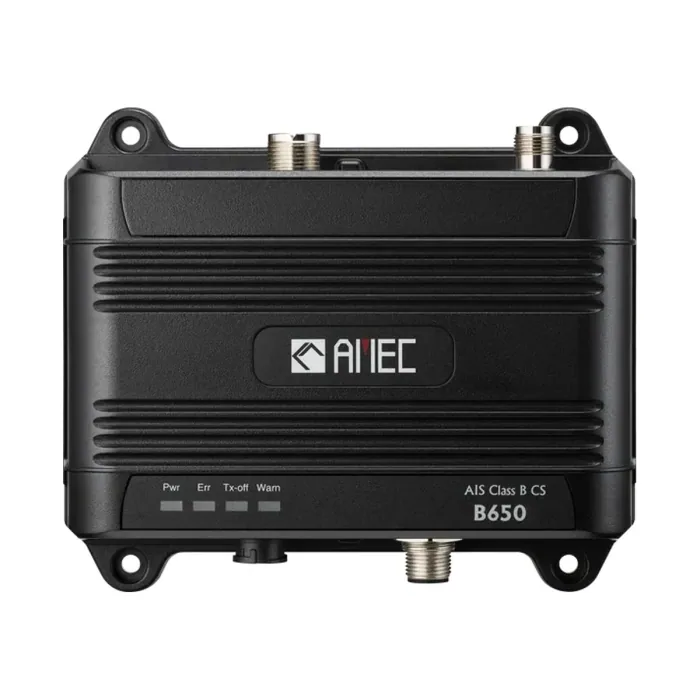
Power matters, but less than people expect, and it cannot buy you distance past the horizon. A Class A transponder transmits at 12.5 W. A Class B SO unit such as the AMEC WideLink B650 transmits at 5 W, with a 1 W option, and a Class B CS unit such as the AMEC B620S transmits at 2 W. The Digital Yacht AIT6000, iAISTX Plus and Nomad 2 are all 5 W Class B units.
The difference between 2 W and 5 W is real, roughly 4 dB, and shows up as more reliable decoding at the fringe of coverage rather than as a dramatic extension of it. Beyond the radio horizon, no amount of power helps, because the signal is passing over the receiving antenna rather than reaching it weakly. If you want to be seen further away, raise the antenna before you upgrade the transmitter.
Receiver sensitivity and the other half of the link
Range is a two ended calculation. What you can see depends on the receiver as much as on the transmitters around you. The AMEC WideLink B650 specifies receive sensitivity better than -111 dBm at 20 percent packet error rate, and the AMEC Cypho-150S and R150GE receivers both specify -112 dBm. Small differences here translate into a modest but genuine extension of the distance at which weak targets decode cleanly.
The things that quietly cost you range
- Antenna height. The dominant factor, and the only one with a square root relationship working in your favour. Every metre counts.
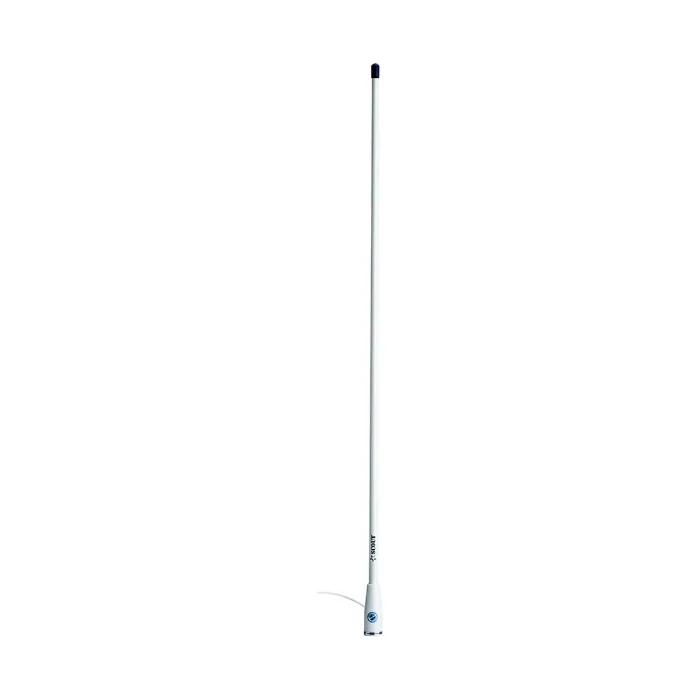
- Antenna tuning. AIS sits at the top of the marine VHF band. An antenna specifically tuned near 162 MHz, such as the Digital Yacht GV30 combination VHF and GPS antenna or the KS30, performs better on AIS than a general purpose VHF whip.
- Cable loss. Long coax runs and cheap cable eat signal in both directions. Keep runs short and use good cable and connectors.
- Splitter insertion loss. Sharing one antenna between the VHF radio and the AIS costs a little signal both ways. It is usually a fair trade for avoiding a second mast fitting, and units with an integrated splitter such as the AIT6000 or the AMEC B620S are engineered around that loss, but it is not free.
- Obstructions. Metal masses, superstructure and radar scanners in the antenna's near field distort the pattern and create blind arcs.
- Channel congestion. In very busy waters the two AIS channels fill up. Class B CS units use carrier sense access and will defer when the channel is occupied, so in heavy traffic a CS transponder can lose transmission opportunities where a SOTDMA unit, which reserves its slots, holds its place.
Beyond the horizon
Terrestrial AIS stops at the horizon, which is why coastal AIS coverage ashore is a network of shore stations rather than a single site. Satellite AIS extends the picture offshore by receiving AIS transmissions from orbit, and some transponders are built to support it: the Digital Yacht AIT6000 and Nomad 2 are SPAIS enabled, adding messaging intended for satellite reception. That does not change your ship to ship range, but it does mean your position can be picked up well outside coastal coverage.
Getting the installation right
Two things matter more than anything else in an AIS install: the VHF antenna needs height and clear line of sight for range, and the GNSS antenna needs an unobstructed view of the sky, since a poor position fix corrupts what you broadcast regardless of how far it travels. ASPL supplies, installs and commissions AIS equipment from AMEC and Digital Yacht across India, including antenna siting and interfacing to the vessel's navigation systems.