
AIS and Digital Selective Calling are often installed at the same time, wired to the same GNSS source and sometimes sharing the same antenna, so it is easy to treat them as one piece of equipment. They are not. They are two independent systems that happen to occupy neighbouring parts of the marine VHF band, and each one covers a gap the other leaves open. Knowing which is which matters when something goes wrong at sea.
Two systems, one band
AIS is a broadcast system. An AIS unit combines a GNSS receiver with a dedicated VHF transceiver working on two international channels, 161.975 MHz and 162.025 MHz, and sends a short data burst on a fixed schedule carrying identity, position, course and speed. Nobody is addressed and nobody replies. Every AIS-equipped vessel and shore station in VHF range simply hears it and plots it.
DSC is a calling system. It uses a single dedicated channel, channel 70 at 156.525 MHz, to send short digital messages addressed either to one specific station by its MMSI or to all stations in range. A DSC call is not a conversation. It is a signal that establishes contact and tells the receiving radio what to do next, usually switch to a working channel for voice, or in the distress case, sound an alarm and display the position.
The two share an identity. Both an AIS transponder and a DSC-equipped VHF radio are programmed with the vessel's MMSI, the nine-digit Maritime Mobile Service Identity issued by the national administration. That shared number is what lets a bridge watchkeeper see a target on the chartplotter, read its MMSI off the AIS data, and place a direct DSC call to that one vessel without broadcasting on channel 16.
What each one actually does in an emergency
A DSC distress alert is the primary tool. Pressing and holding the distress button transmits an alert on channel 70 containing the MMSI, the nature of distress if it has been selected, and the position if the radio has a GNSS feed. Every DSC radio in range receives it, along with coast stations, and the alert repeats until acknowledged. This is the mechanism that raises the alarm.
AIS does not raise an alarm in that sense, because AIS has no distress button and no acknowledgement. What AIS does is keep the picture accurate. A vessel in trouble that is still transmitting AIS is continuously reporting where it is and how fast it is moving, which is exactly what a responding vessel needs once the alert has been received. Dedicated AIS safety devices work by broadcast too: AIS SARTs and man overboard beacons transmit on the same two AIS channels and appear on any AIS display in range, without needing a DSC radio in the loop at all.
Why a GNSS feed matters more than people expect
A DSC distress alert without a position is far less useful than one with a position. Some fixed-mount radios solve this with an internal GNSS receiver, so no separate antenna or wiring is needed. The Icom IC-M424G, for example, carries an internal 66-channel GPS receiver and NMEA 2000 output, so position data feeds DSC calls and connected chartplotters without a separate GPS antenna. Others expect a position feed over NMEA from an existing GNSS source, which means the wiring between chartplotter, AIS unit and VHF radio is not optional detail. It is part of the distress function.
Sharing antennas and combining functions
Because AIS and marine VHF voice sit close together in frequency, the two can share a single mast-top antenna through a splitter, avoiding a second fitting. Several units build the splitter in rather than leaving it as a separate box. The AMEC B620S and AMEC WideLink B650S both add an integrated VHF splitter with a dedicated radio connector to the standard transponder platform, and the Digital Yacht AIT6000 does the same in a Class B+ unit with alarm outputs, NMEA 2000 and Wi-Fi.
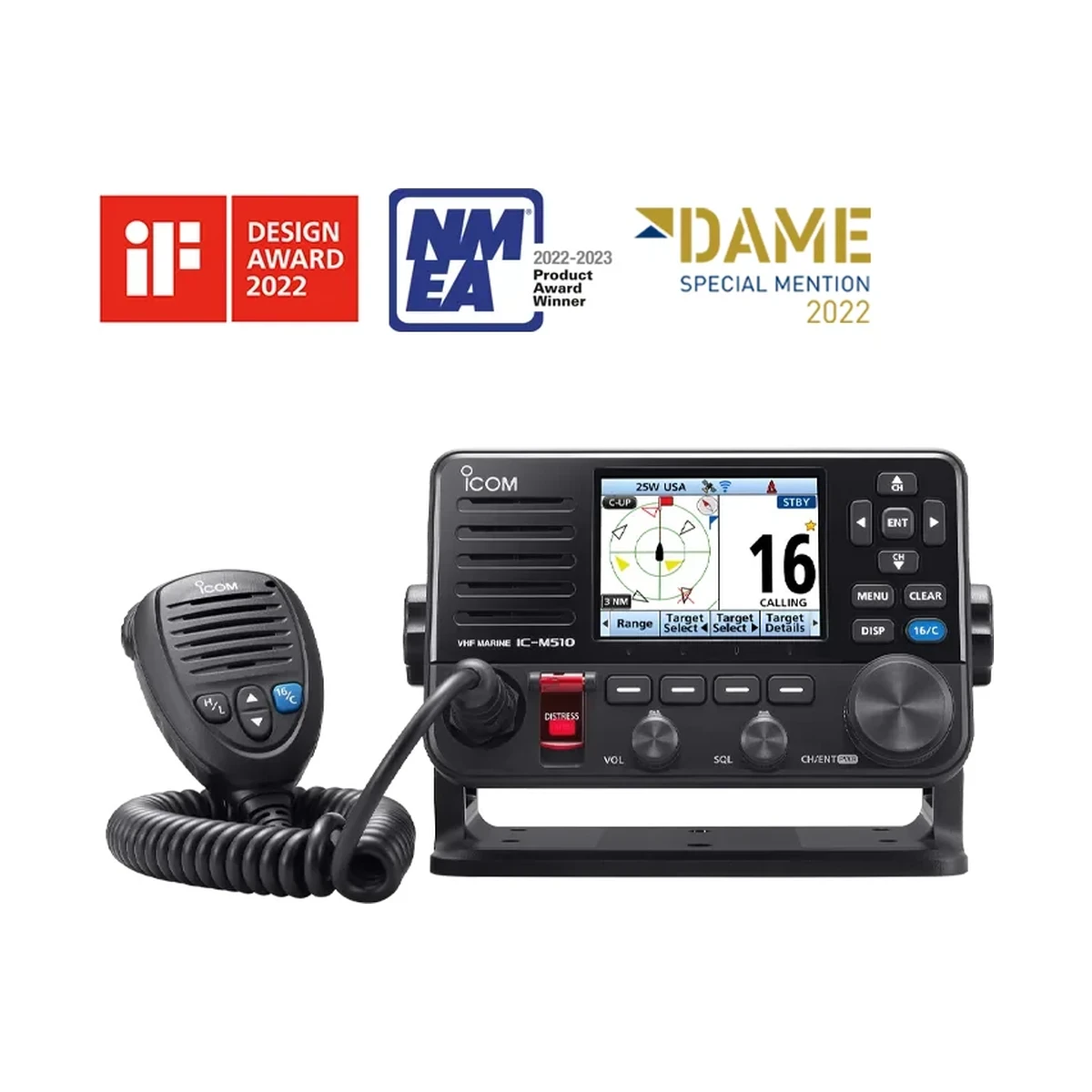
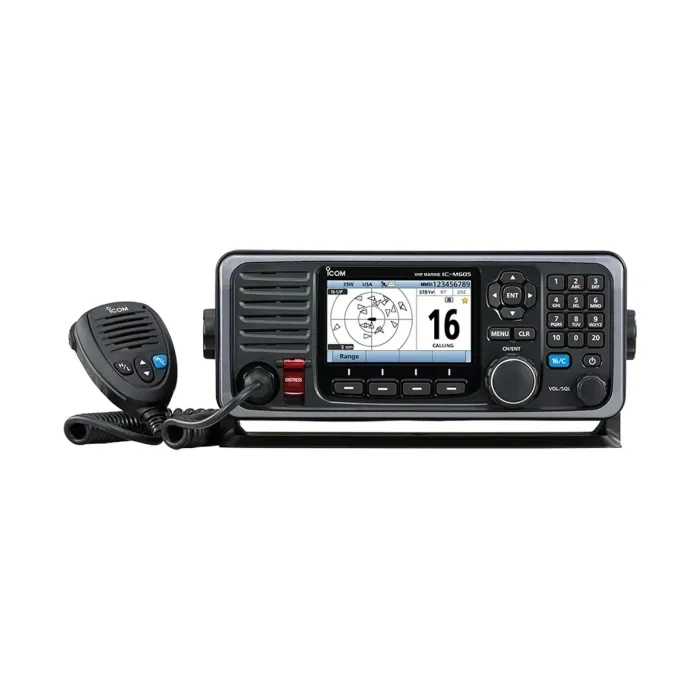
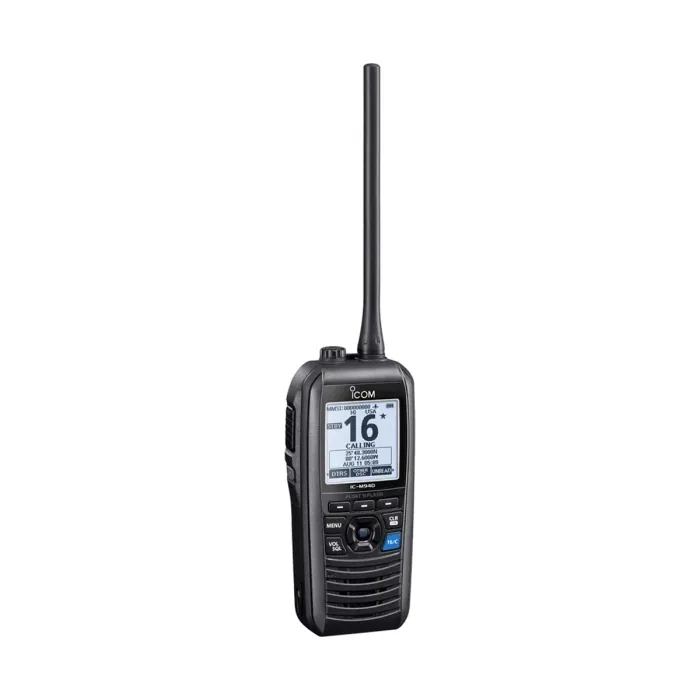
Combination in the other direction is common as well. Radios such as the Icom IC-M510 Class D and IC-M605 include dual-channel AIS receive alongside DSC on 156.525 MHz, so a single fixed-mount unit handles voice, DSC alerting and AIS target reception. The handheld IC-M94D packages DSC and a single-channel AIS receiver into a portable IPX7 radio. These are receive-only for AIS. They will show you traffic but they do not make you visible, so a vessel that needs to be seen still needs a transponder.
Specifying the pair sensibly
- Confirm the vessel's MMSI is programmed identically into both the AIS transponder and the DSC radio before commissioning, and that neither has been left on a default or a previous owner's number.
- Decide early whether the DSC radio takes position from its own internal receiver or from the vessel's NMEA network, and wire accordingly.
- Choose between a built-in splitter and a dedicated second antenna based on available mast fittings, not on price alone. A dedicated antenna avoids any splitter loss on either path.
- If AIS is being added purely for situational awareness on a vessel with no carriage requirement, a receiver or a radio with AIS receive built in may be enough. If the vessel needs to be seen, it needs a transponder.
- Check the AIS unit will alarm on AIS SART and MOB transmissions, which is a software feature rather than a hardware one, and not universal.
ASPL supplies AIS transponders, GMDSS equipment and marine VHF alongside the NMEA 0183 and NMEA 2000 interfacing that ties them together, and commissions the result as a working bridge rather than a collection of boxes.